The Old Limitations No Longer Apply — Part 4: What's Left to Build?
October 12, 2026
A Singularity Log Special · Part 4 of 4
In this series
- The Price of Admission
- The Rentier's Last Stand
- What Happens When We Can Make Our Own?
- What's Left to Build? — this essay
Previously
- Part 1: AI lowers the price of turning an intention into working software, letting the idea come before the apprenticeship.
- Part 2: Cheaper alternatives weaken subscription moats; a tool built for one person can succeed without winning a market.
- Part 3: Making our own tools gives us control over accessibility and opens space for projects too small to sell.
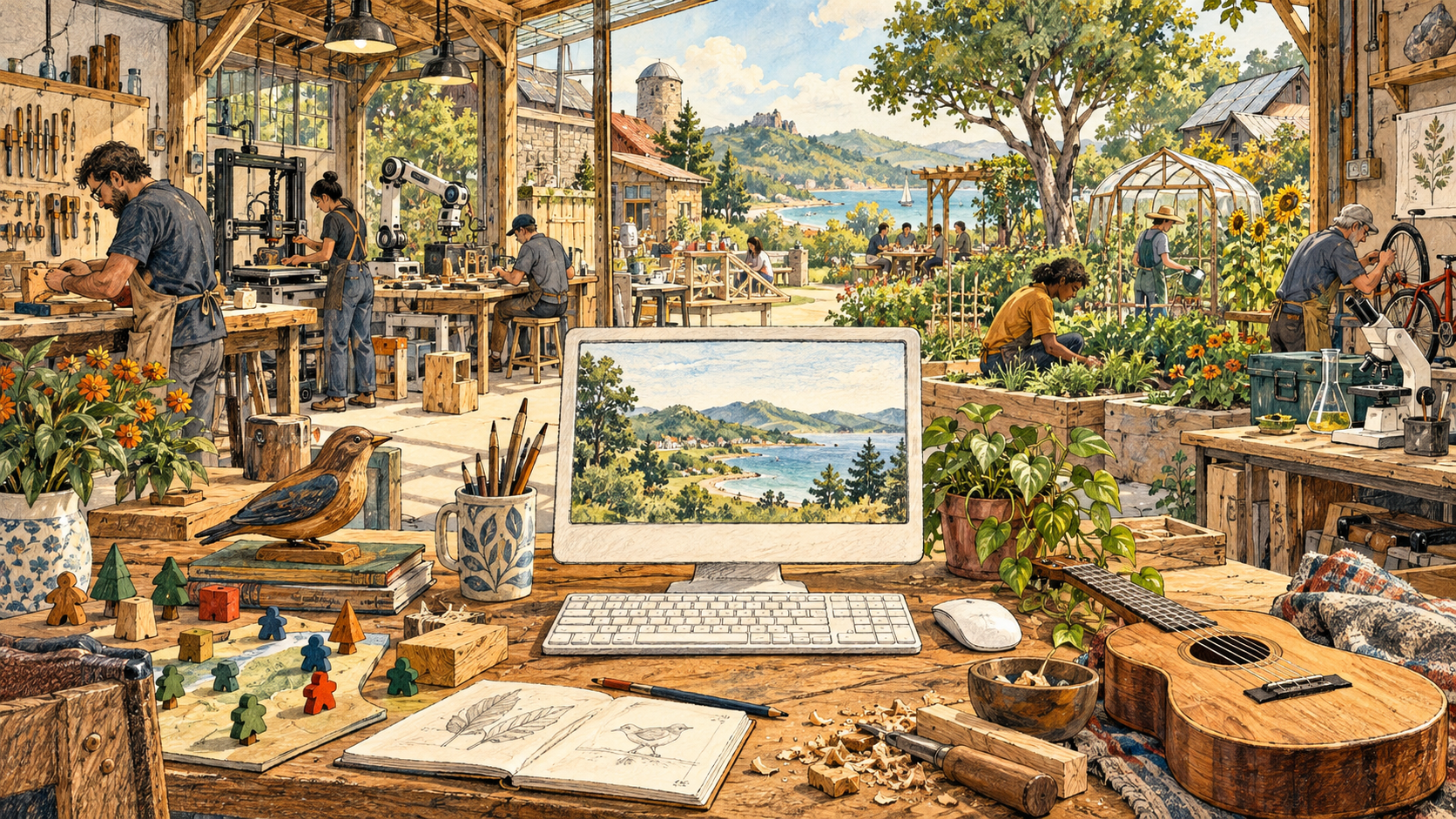
Building tools for ourselves separates two questions we've spent years confusing: whether something improves a person's life, and whether somebody can make money selling it. The rest of the economy still demands its due.
Living After the Limit
I'm unemployed while writing this. I can assure you that building an entertainment system does not make the mortgage disappear.
AI systems require infrastructure, consume energy, and depend on companies whose interests can clash with ours. Access depends on money, connectivity, technical literacy, and a willingness to wrestle with tools that fail.
People also depend on the work that's becoming cheaper to perform. An economy can produce more without sharing the gains. Much of industrial capitalism's history consists of that struggle. Institutions built around scarcity defend themselves, and ownership and power will shape who benefits from AI.
But an increase in productive freedom doesn't have to resolve every injustice before we can recognize it. Unequal access doesn't make abundance imaginary. New problems don't restore the old limitations.
For much of my life, I approached technical projects by asking whether they were worth the trouble. I had limited time, limited energy, and more ideas than I could execute. I rationed my imagination. Now I find myself asking: why not try?
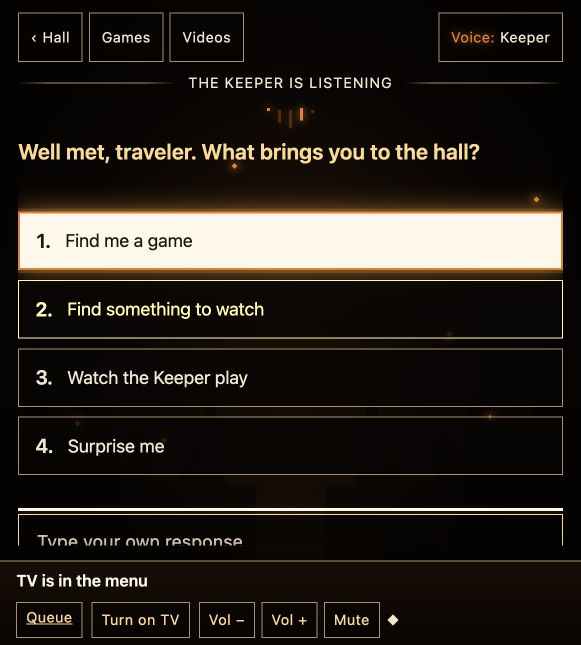
The Keeper begins with what a person wants to do, offering labeled choices and space to answer in their own words. No recommendation request was submitted for this capture.
When experimentation costs less, you can explore an idea without knowing whether it will succeed. Build something to discover whether you want it. Follow curiosity without signing away months of your life.
Failure becomes cheaper. You can afford more attempts, including the ones you used to dismiss. You still need judgment, taste, and the persistence to spot what's wrong and keep working until you fix it. As implementation costs fall, those choices determine more of the result.
The Old Limitations No Longer Apply
I don't know whether historians will name a moment when the technological singularity occurred. There could be an unmistakable breakthrough. The concept could also fail to describe what happens. For an ordinary person, I suspect the experience will arrive through a succession of inconveniences becoming solvable.
You build a little application instead of searching for one. A project you've contemplated for years fits into a weekend. You attempt work that once demanded a team and remember afterward that it used to be difficult. Then you stop being surprised.
That's the part I keep returning to. I asked a computer to operate my television and treated the unfinished connection as a configuration problem. The capability had entered my expectations before I'd finished making it work. I've begun taking for granted freedoms that would have astonished me a few years ago.
Start examining the limitations you've learned to live with. The tools you wish existed. The projects you've abandoned. The frustrations you've accepted because fixing them cost too much. The things you pay for because building an alternative seems unreasonable. Reconsider the cost.
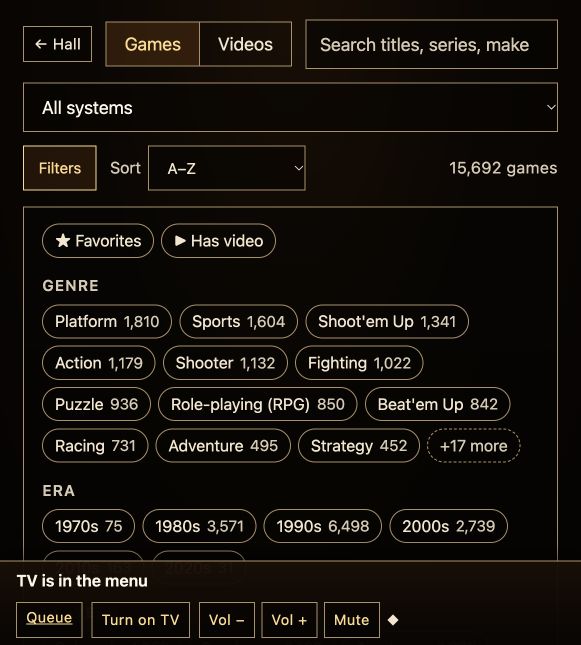
Custom browsing controls make a large collection approachable through the categories its owner wants to use.
Some obstacles remain. Asking a machine for help doesn't make every problem trivial. But the obstacle you remember may have shrunk, or a path may have opened. Once you've seen that happen a few times, you start looking for the next one.
I started this essay because I asked a computer to turn on my television. It didn't work. I still need to connect the pieces, and I'll encounter more problems before I'm satisfied. But I'm going to finish it, because I can. I'll have an entertainment system built around my preferences, on hardware I own, using software I can modify.
A few years ago, I wouldn't have bothered. Tonight, the remaining work feels like a minor inconvenience. That changes the economics of my life even if it doesn't show up in my bank account.
(This is coming for everything, by the way. And it's going to happen to you, too, sooner than you expect.)
We've confused the difficulty of building something with the value of having built it. When implementation was expensive, a company's years of development helped protect its product. Now an individual can sometimes make a credible approximation in an afternoon. It may lack polish, reliability, or scale, but it can accomplish what that person wanted. And good enough can gut a subscription business when the alternative costs twenty dollars a month forever.
What do we build when we don't need a market? Software for five people, or one. Accessibility tools shaped around one person's disabilities. Games built from a dozen friends' shared jokes. Educational software following a single student's curiosity. Household systems that work the way their owners want. Personal and community infrastructure nobody would have considered turning into a company.
Those are needs the market couldn't justify serving. Meeting them gives us a different way to measure progress: how many people can make something that matters to them?
The question reaches beyond the screen, into fabrication, robotics, scientific instruments, and the physical world. Atoms still cost money. Some systems demand enormous infrastructure, safety guarantees, coordination, and expertise. But a handmade object that solves your problem doesn't have to become a bestselling product to matter.
The old software industry asked us to imagine products that could serve millions of people. These tools allow millions of people to imagine things that serve themselves. Commercial viability became our proxy for human value, but an idea doesn't need a business model to make somebody's life better.
We're gaining access to a part of our imagination that never had an economic reason to exist. Stop requiring everything worth making to survive as a product, and the question of what's left to build opens onto a much larger world.
Everything we never bothered to imagine because we knew we couldn't afford to make it is now within reach. And it starts, as it never has before, with natural language.