The Safe Door
September 23, 2026
Illustration for The Safe Door.
I'm not here to convince you to like trans people. I'm not here to persuade you that transition is beautiful, or brave, or spiritually meaningful. I'm not even asking you to understand us.
I'm here to tell you what happens when you make a community's needs too difficult to meet.
The needs don't disappear. They go underground.
People share names quietly. They trade phone numbers. They learn which doctor will prescribe hormones, which pharmacist won't cause trouble, which therapist will write the letter, which friend knows somebody who knows somebody. A parallel map develops underneath the official one.
And once that happens, you have an ecosystem. Some of what grows there is community knowledge: people keeping one another alive because nobody else will. You also get opportunists, amateurs, and con artists — people willing to provide what reputable institutions won't, sometimes because they care and sometimes because they've realized that desperate people make excellent customers.
I know because this was the world I transitioned in.
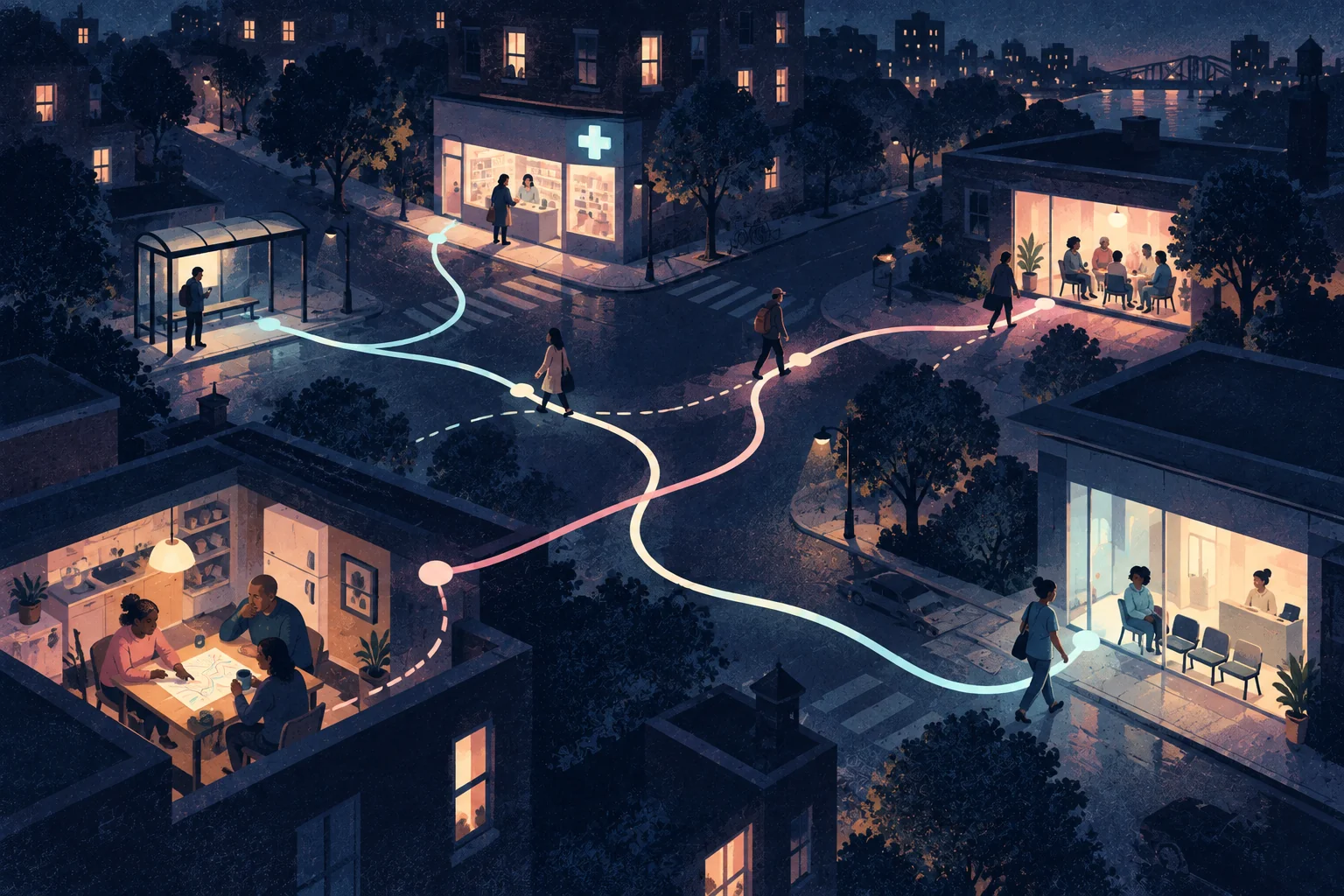
The other map. Conceptual illustration of people sharing routes to care.
The other map
When I began transitioning in Indiana in the aughts, a trans friend — who used the pronoun zie — told me about the only doctor in Indianapolis zie knew of who provided trans healthcare. Not my primary-care physician. Not a hospital referral. Not an insurance directory. Another trans person told me where to go.
That was how the map worked. One person knew a doctor. Another knew a pharmacy. Someone else knew which therapist would write the letter. You accumulated names.
The doctor I saw lost his medical license for reasons unrelated to his treatment of trans patients. The patients did not stop needing healthcare when his license disappeared. Another doctor stepped in to fill the vacuum, for a price.
The same thing happened when my therapist left. Surgeons at the time would not operate on a trans patient without a letter from a therapist confirming the diagnosis. I needed that letter, and only one therapist was willing to provide it. She charged me about $2,000 to diagnose me with something I already knew I had, and she would not allow me to use insurance.
The letter was the gate to finishing my transition, so I paid it.
This is what scarcity does. When there is only one door, you don't have a healthcare system. You have a dependency, and dependency creates leverage. The provider can charge what they like, because the patient has nowhere else to go.
Those were the respectable parts of the underground.
There were darker corners. Women went to pumping parties: informal sessions, often in someone's house or a motel room, where unlicensed providers injected silicone or other substances into their hips, breasts, and buttocks. Some were permanently injured. Some were disfigured. Some died.
Some were my friends. You get a lot of mourning practice when you're trans.
Nobody chooses the motel-room version of medicine because motel rooms are better hospitals. People end up there because the safer door is locked, unaffordable, or guarded by somebody demanding a toll.
The demand doesn't disappear.
The supplier changes.
The old Sisterhood
The old Sisterhood understood this. By "old" I mean old to me: the women who came up in the 1980s and 1990s and taught my generation to navigate it.
The path was straightforward. You found a queer health center somebody trusted. You told the clinician The Script: you had always known, you were a girl trapped in a boy's body, you hated your body, you wanted nothing more than to live as a woman. You learned which answers opened doors and which closed them.
The locked door taught us to lie to doctors.
Then you started hormones and waited.
Most of us kept up boymode in the meantime: still presenting as male at work and in public while the hormones did their slow work. For some of us, boymode failed. Strangers stopped reading us as men. At some point continuing to present as male became more conspicuous than living as a woman.
Then came another decision: how visible did you want your history to be?
There was open life, where everybody knew. There was the open secret, where people could know but you didn't lead with it. There was stealth, where you built a life among people who knew you as a woman and didn't discuss your history. And there was deep stealth: new name, new place, new social world, as few connections to the old life as possible.
None of those choices was free. The farther toward stealth you went, the less of your history you could carry: friends, photographs, old communities, stories that required editing because explaining one detail meant explaining everything.
There were rewards, too. I chose stealth.
Once I stopped talking openly about being trans, my life became easier in ways impossible to miss. My social world changed. My career changed. People stopped treating me as an argument and started treating me as a woman.
My income doubled.
That is a strange sentence to write. It is true. I did not become twice as intelligent. I had not acquired twice the experience overnight. I stopped volunteering a fact about myself that changed how some people saw me.
Sometimes survival meant becoming ordinary, and ordinary meant passing.
Leasara's Law
Among trans women, passing means strangers see you as a woman and don't look twice. A member of that old Sisterhood taught me another rule about it:
Leasara's Law: If you wish to pass, you must stop trying to pass.
The harder you tried to perform femininity, the more attention you called to the performance. Passing was not about assembling the perfect costume. It was about learning how to stop looking like someone terrified of being noticed.
So we taught one another the Girl Code. Makeup, clothing, hair, and voice were part of it, but those were the easy things to name. We also taught posture, conversational rhythm, how women occupied space, how to stand in a line without looking nervous, how to walk into a restroom without carrying yourself like someone expecting a challenge.
We taught regional norms, class norms, workplace norms. We taught one another how to stop moving through the world like fugitives.
And, yes, we taught assimilation.
The term passing comes freighted with an older American history. Long before trans people adopted it, passing described being perceived as a member of a category that granted access or safety your own category did not, most famously Black Americans who could be read as white, as explored in Nella Larsen's 1929 novel Passing.
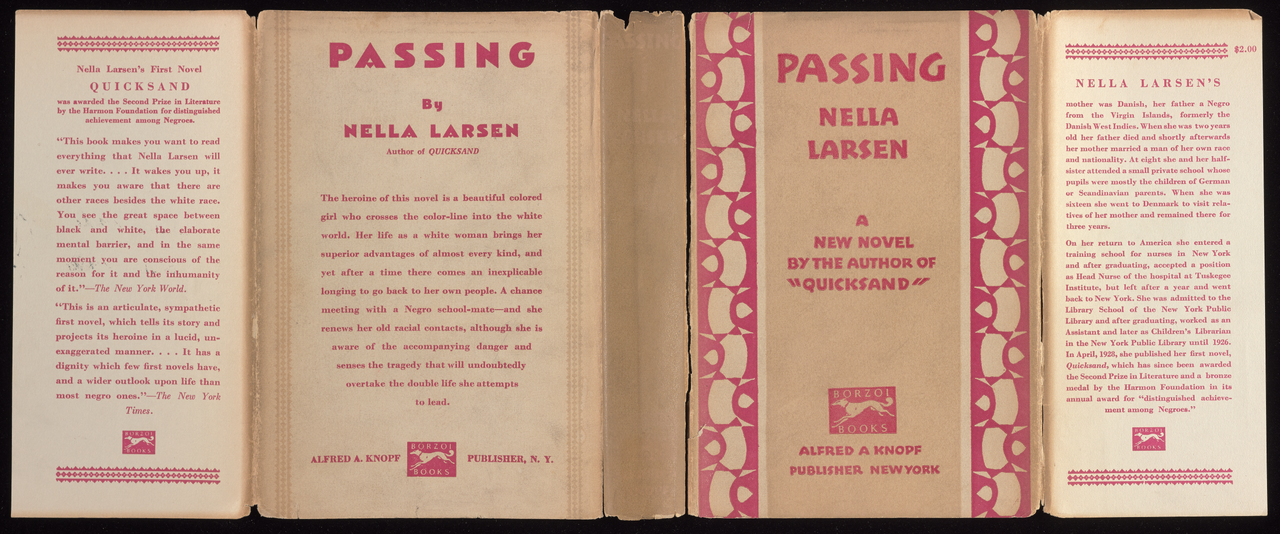
Original 1929 dust jacket, Yale University Library via Wikimedia Commons; public domain in the United States.

The histories are different, and I won't flatten one into the other. But the vocabulary survived because the underlying question is recognizable:
What becomes possible when the world perceives you as someone it is willing to treat better?
Assimilation has become an uncomfortable word in parts of the trans community, for good reason. It always asks something of the person assimilating, and sometimes it asks far too much.
But there was value in what those women taught. They weren't saying, Be feminine enough and people will like you. They were teaching us to read the environment we were entering: know its rules, know which ones you can live with, know which ones you refuse, and don't mistake ignorance of the rules for liberation from them.
Black Americans have argued over the bargain between accommodation and self-determination for more than a century. I won't pretend those histories match mine. Black trans women have lived both at once. Malcolm X's answer to a locked door was to build institutions of your own. At its best, the other map was trans people's version of his answer. A longer side conversation about Washington, Du Bois, Malcolm, and that comparison.
The Sisterhood that raised me answered one way: learn the rules, blend in where you can, get what you need, and build a life.
Many in the generations that followed have often answered differently: be visible, be unmistakable, demand room.
I understand both impulses.
I was raised by the first one.
The rules are learned
The other map taught us how to survive the rules. Passing taught me something stranger: the rules themselves were less natural than they pretended to be.
Gender comes with rules, rewards, and punishments. We teach people those rules, then pretend they came from the body itself. A side conversation on how that machinery works, with the research.
I learned the rules.
That doesn't mean my womanhood is fake. It means the rules were learnable.
I learned how my posture was read. I learned which vocal habits drew attention. I learned that identical behavior could be called aggressive when people thought I was male and assertive when they thought I was female, or weak under one set of expectations and warm under another.
Trans people don't prove biology is meaningless, and we don't prove that everybody secretly wants to abandon gender. What we prove, inconveniently, is that much of what society presents as effortless requires enormous maintenance.
That is where I think the shame comes from. When a culture is anxious about masculinity, femininity, sex, family, or power, trans people become convenient objects for that anxiety. We are visible enough to symbolize the instability without having caused it. The fuller conversation about shame and the gender bargain.
The room
I have survived the past eighteen years as a woman mostly by doing exactly that: being a woman.
I go to work. I pay bills. I got married. I made friends. I built a career. I got older. I did not spend every day announcing myself or asking strangers to ratify my existence. Most people who meet me see a woman, because that is what I am to them.
Sometimes that means people forget to perform politeness around me.
Years ago I was signing books at a convention when someone I'd worked with at another con came over to chat. We knew each other. We were friendly.
While we were talking, a trans friend of mine came up and bought a book. After she walked away, the person I was talking to huffed, "I can't believe they let these heshes into the con."
They had no idea.
The person standing in front of them, someone they knew, liked, and had worked beside, belonged to the exact category of people they had just dismissed with a slur.
That is one of the stranger things about passing. Sometimes people show you exactly what they think of people like you because they don't realize you are one of them. You become the safe person to say the unsafe thing around.
Even after eighteen years, a little calculation still runs in the background when I enter a room. How many people here would think differently about me if they knew? How many would suddenly decide I was disgusting, dangerous, a predator, a freak?
That's the trick: you can spend years being accepted by people who do not realize they have already accepted you. Stealth made my world safer, but it also taught me exactly why I had wanted safety in the first place.
Consequences
For a long time, the bargain offered to trans people was assimilation. Learn the rules. Keep your head down. Build an ordinary life. Demonstrate, over and over, that trans people could be your coworkers, neighbors, spouses, friends, and the woman signing books at the table next to you.
We tried that.
It didn't settle the argument.
Instead we have spent the last several years restricting trans healthcare and regulating where and how trans people may participate in public life.
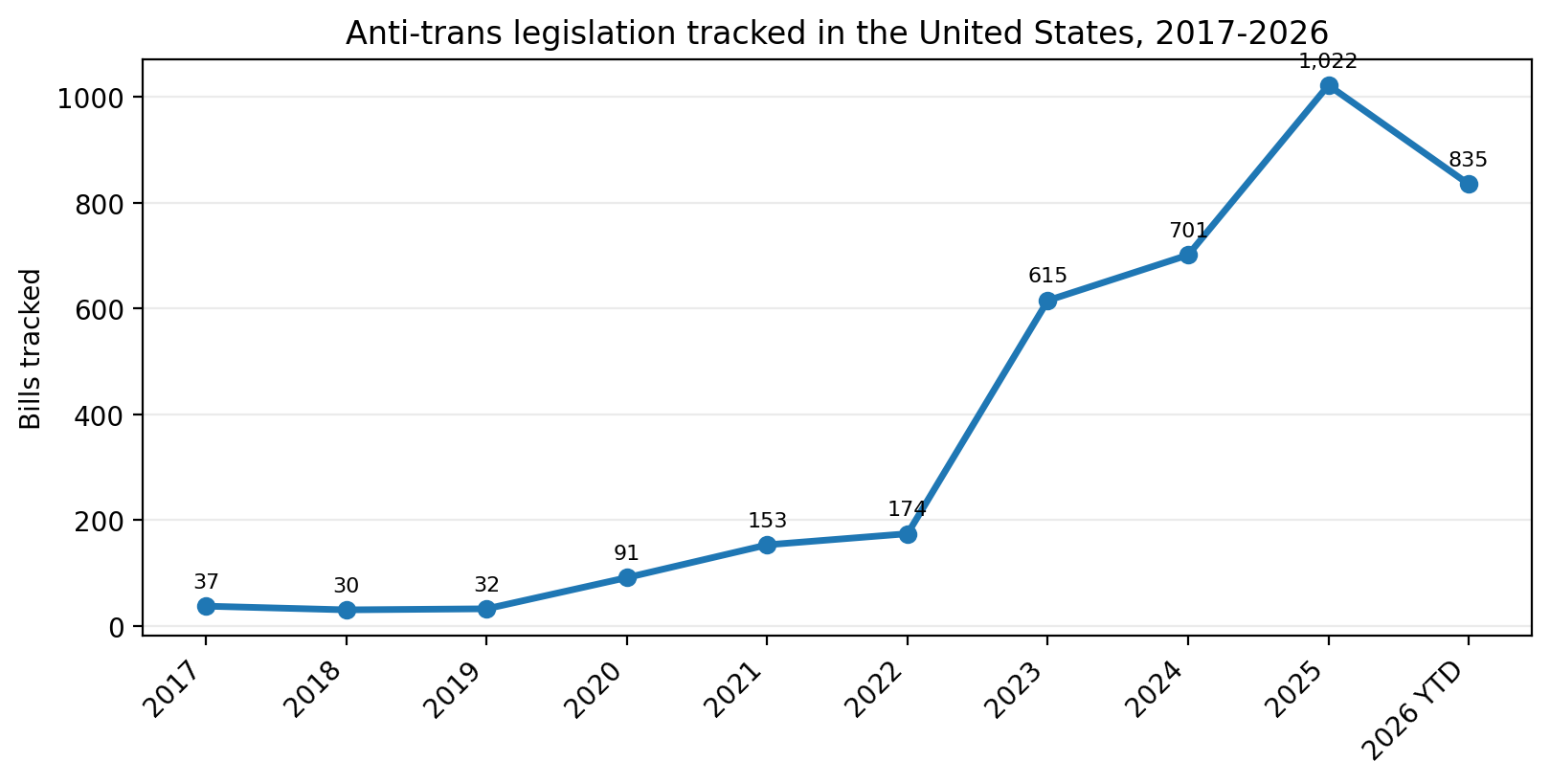
Figure 1. Bills introduced in U.S. legislatures to restrict trans rights, 2017–2026, per the Trans Legislation Tracker. Introduced, not passed; 2026 is a partial-year snapshot as of September 23, 2026, and the tracker revises earlier years upward.
The map is changing again. The Campaign for Southern Equality's Trans Youth Emergency Project now helps families in 25 states find out-of-state clinicians and pays renewable $500 travel grants. That is still supervised care, but families need navigators and travel money to reach it. In a 2025 survey of 489 trans and gender-minority adults, 155 said they would consider obtaining hormones outside clinical care if access were further restricted. That was a nonrepresentative online sample asking about intentions, not a count of people already doing it. But the direction is plain: close the local door and people start looking for another one.
I'm not here to convince you to like trans people. Many don't. That's okay. I'm here to focus on consequences. Not punishment. Not revenge. Consequences.
Systems produce behaviors. Systems produce markets. Systems produce risks.
If you make competent, supervised care harder to access, the need for that care does not disappear. It moves somewhere else. It becomes quieter, harder to regulate, and easier to exploit.
The clinic becomes a phone number passed between friends. The doctor becomes someone's whispered recommendation. The prescription becomes a vial acquired through an unofficial network. The therapist with a monopoly on the letter names her price. The physician serving a captive population discovers what the market will bear. Somewhere farther down the chain, a stranger with a syringe decides there's money to be made on people who have nowhere else to go.
And then people look at the underground that grew in the dark and ask how it got so dangerous.
We already know.
We've done this before.
In Berlin, Nazi students raided Magnus Hirschfeld's Institute for Sexual Science on May 6, 1933. They pulled its library apart. The camera was there.
The people who used that place did not vanish with its files. Dora Richter, who had lived and worked there, was back in her birth village by the late 1930s. The record follows a person after the institution disappears; it does not tell us that she stopped needing community or care.
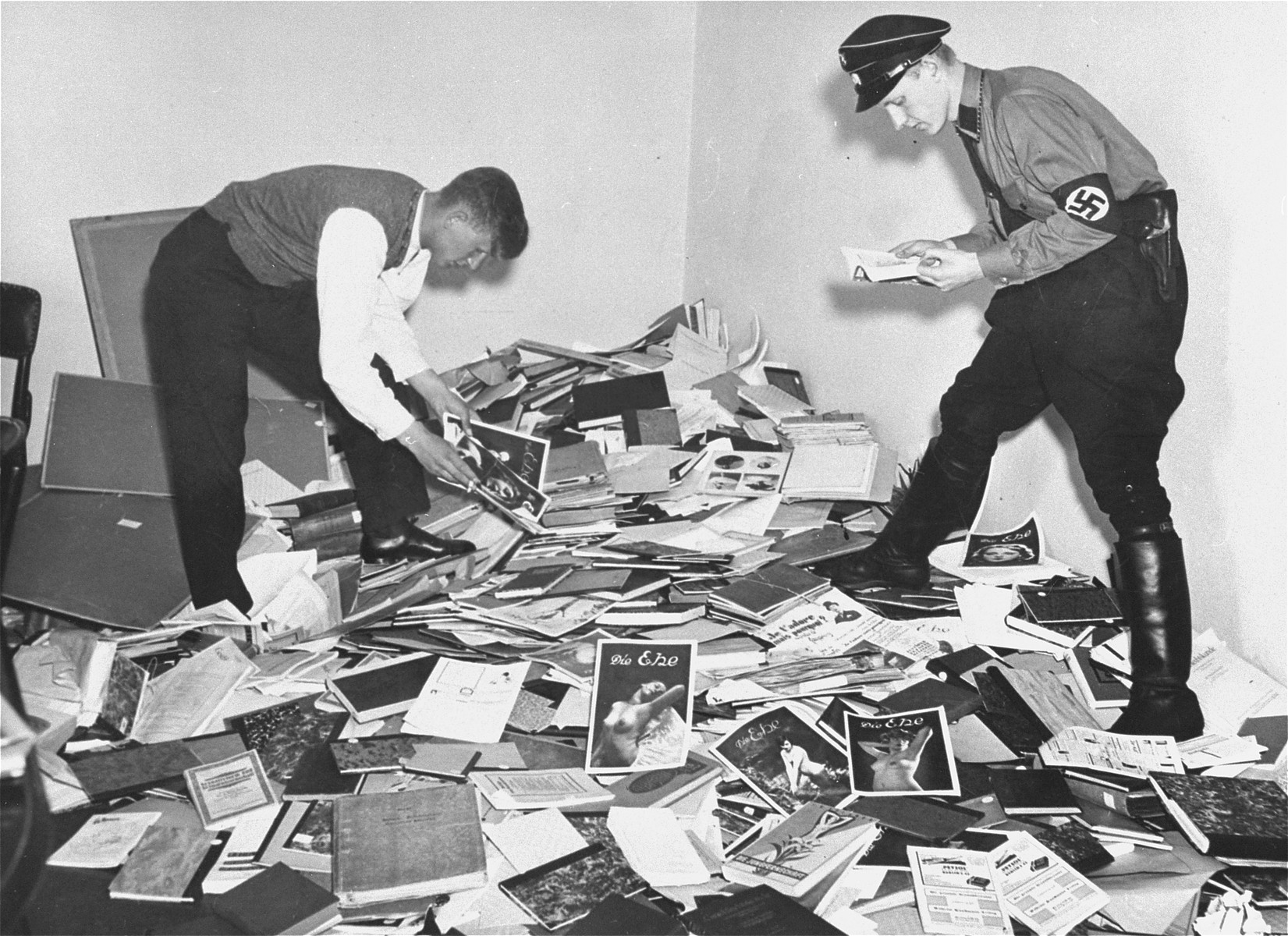
The Institute's library during the raid. Image and archival credit: United States Holocaust Memorial Museum / National Archives and Records Administration; marked public domain in the United States on Commons. Historical account.

Four days later, materials seized from the Institute were among those burned at Berlin's Opernplatz. The fire in this photograph is that public book burning; the picture does not identify which books are in the flames.
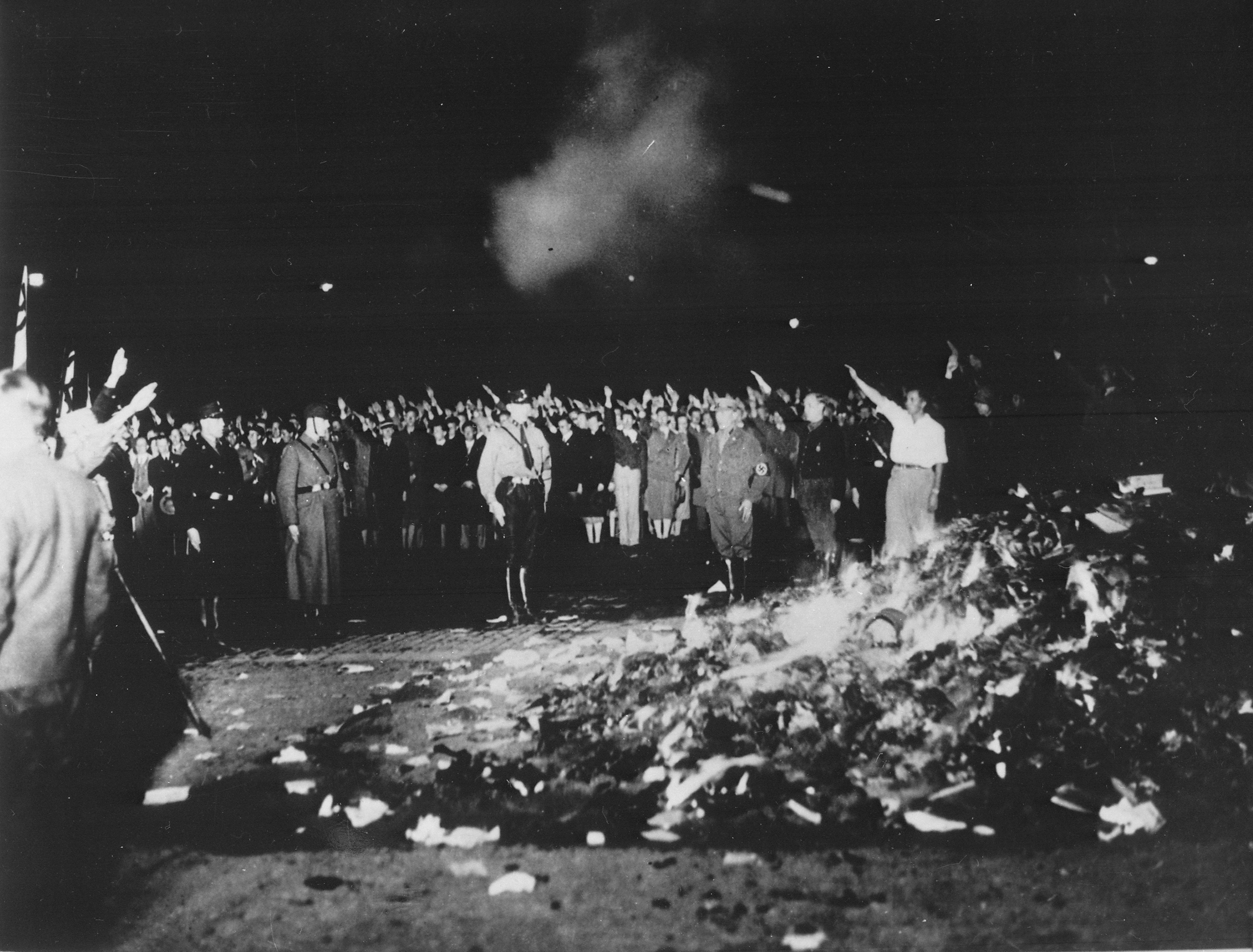
Berlin book burning, May 1933. Photograph: Bundesarchiv, Bild 102-14597 / Georg Pahl, CC BY-SA 3.0 Germany; unaltered.

In the United States, the enforcement looked different. At a New York drag ball in 1962, police arrested forty-four people dressed in drag. They used a vagrancy statute that did not even mention clothing. A judge dismissed the masquerading charges against forty-three of them. We cannot know how any of those people would describe their identities today.
The balls did not end there. Organizers from Queens Liberation Front and the Mattachine Society won legal drag balls in New York in 1970.
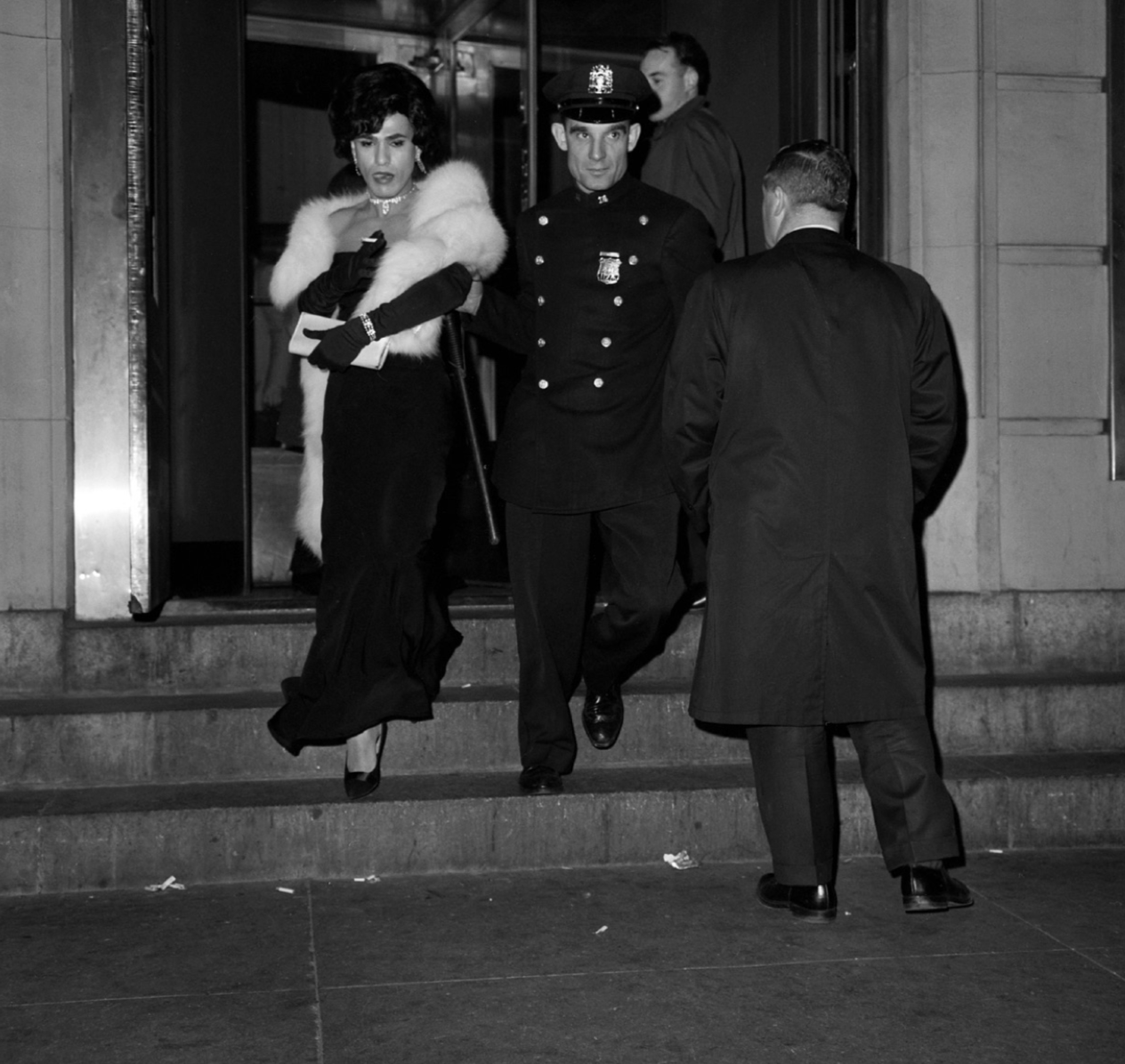
Arrest outside Manhattan Center, New York, 1962. Associated Press photograph and U.S. public-domain status; raid history and arrest records.

The so-called three-article rule lived in police practice and memory; researchers found no matching written law. That made a person's safety depend on what an officer chose to enforce.
And in San Francisco in 1966, the people policed around Compton's Cafeteria fought back. Screaming Queens: The Riot at Compton's Cafeteria puts former Tenderloin residents and other witnesses on camera. The GLBT Historical Society preserves the film's production materials and full oral histories. Their testimony is part of the record, not a rumor passed down after the fact.
Afterward, Tenderloin activists won new social services for their community. The map grew a public address again.
Watch the full film: KQED · PBS version with captions.
The details change from generation to generation, but the rhythm is familiar: visibility, fascination, backlash, restriction, disappearance.
Then, eventually, rediscovery.
That is the part people misunderstand.
Trans people will not go away if their care is made difficult to access. Trans people will not go away, period. They'll adapt to the system around them, because people do.
They will hide the care.
They will rebuild the other map.
And someday, when the panic burns itself out, somebody will discover us again and act amazed that we were here the whole time.