Take the guide offline
The illustrated guide includes the expanded Thompson Center maze, old Chicago Cyclotron encounter and eleven named character profiles.
Download the illustrated guide (ZIP)A free Savage Worlds module
An eight-gathering adventure through a changing Chicago and the strange realities beyond it.
Read the GM guideThis guide includes campaign spoilers. If you’ll be playing, consider leaving the discoveries to your GM.
Unofficial fan module.
Requires the SWADE core rules.

Free materials for your table
The illustrated guide includes the expanded Thompson Center maze, old Chicago Cyclotron encounter and eleven named character profiles.
Download the illustrated guide (ZIP)An optional local Game Master companion can retrieve scene briefings, track revealed clues and pressure clocks, record outcomes, and produce session recaps in a compatible desktop AI client. The GM directs changes.
Set up the MCP companionIt follows the 24-scene campaign outline. Use this guide for the expanded maze and cyclotron mechanics. The companion runs on your computer; this page is not an MCP endpoint.
Old heroes. Ten quiet years. A friend coming home by a route that was, in the campaign’s own words, “suuuuper fucky.” Then cartoons spill into the city, civic architecture becomes impossible, and a mayor turns out to have purchased a result that should never have been for sale.
This free module shares an eight-gathering campaign framework, with GM notes, encounters, revelations and branching possibilities. Use its story path as a starting point, then let your group’s choices shape the adventure.
Optional SWADE stat blocks and an encounter roster are ready below. Other open encounter details and setting choices remain clearly marked for your preparation.
Basis: Campaign bible, eight-gathering outline and session pages.
Explicitly decided story beats or intended outcomes. A plan still leaves room for players.
A prepared option or current baseline, deliberately open to revision.
A possible consequence added here to explain a branch. It was not established campaign canon.
A genuine missing detail. The website does not quietly fill it in.
Recovered history is labeled separately. Those old images are remembered; their chronology often is not.
Act I · Session 0 · Planned
Build the portal. Get the gang back together. Let the first mistake matter.
The party builds and activates a portal to bring fictional Mark back. Ordinary skill checks, cooperative Support, Tests, Tricks, environmental problem-solving and a combat threat teach Savage Worlds through an urgent shared job.
The tutorial ends with a returning person, rather than a lecture about the rules.
Mark returns even if the party performs poorly. Failure determines the cost: leaks, damage, an unwanted passenger or another complication. It does not close the campaign before it starts.
He describes a route through contradictory places, unstable passages or the space between universes. Getting here was “suuuuper fucky.” That line foreshadows the last act.
Working design: a clean return versus a return with collateral trouble. Portal construction could become a Dramatic Task. The combat opponent, construction logic, task difficulty and precise consequences were still unknown.
Sources: Session 0; bible: tutorial coverage and travel rules; spine: Act I.
Optional table prep: Mark and rift leeches; see the session encounter roster for counts and scene use.
Act I · Session 1 · Planned
Let the old victory feel real before the world starts misbehaving.
The heroes reacquaint themselves with Chicago after ten peaceful years. Mark recounts impossible fragments from his journey. Small continuity errors are funny first and frightening later.
The gathering closes when the first cartoon becomes undeniably real.
Cartoons were already real in another reality. The problem is separation: realities are coalescing. Whatever higher-dimensional mechanism kept them apart has gravity; its precise nature was not chosen.
The apparent safety is the opening half of a bookend. By the finale, safety will mean freedom from ownership.
Unknown: the first visible error, which cartoon appears, and how much Mark can explain. Plausible extrapolation: investigating the glitches immediately could change how quickly the party notices a pattern; dismissing them could defer that investigation. No specific delay penalty was written.
Sources: Session 1; bible: cosmology and bookend.
Optional table prep: Inez and Pip; see the session encounter roster for counts and scene use.
Act I · Session 2 · Planned
The cartoons are people. The physics are the emergency.
Toon-bodied people and cartoon physics erupt into ordinary Chicago. The main encounter is a rescue and containment problem. Incompatible rules create slapstick and genuine danger at the same time.
Evidence connects the disturbance with city work, weatherization equipment or the mayor’s people. By the end, somebody is visibly benefiting from the chaos.
This is the full Ink and Paint cameo, but no named cameo character was selected. The displaced cartoon people are not disposable monsters. Their presence demonstrates a common explanation for the campaign’s apparently unrelated nonsense.
The city is being shaken. Municipal cleanup is also a trail toward the beneficiary.
Planned principle: creative rescue and containment. Plausible extrapolation: helping displaced people could produce allies or witnesses; treating them as invaders could damage trust. Those consequences, individual NPCs and cartoon-physics rules were not finalized in the original outline. The stat-block reference adds optional Pip and ink-spill builds.
Sources: Session 2; bible: tone rules and coalescence.
Optional table prep: Pip and animated ink spills; see the session encounter roster for counts and scene use.
Act II · Session 3 · Planned
The disasters are manufactured. The repair invoices are somebody’s good news.
The party investigates repeated outbreaks of reality chaos. The mayor’s home-repair and weatherization business profits from the damage. Evidence establishes that an outside actor can deliberately shake Chicago for entertainment.
The mayor either flees or draws the heroes into the Thompson Center.
The human owner was an alderman who wanted to be mayor. Scavenged higher-dimensional technology and an eligible straw buyer let him participate in Up’s estate auction.
He bought the outcome. Higher-dimensional interference made him mayor. Repair money is useful corruption and a clue trail; it is not the necessary mechanism behind his political success.
Planned: a fleeing mayor or a deliberate lure into the maze. Independent clues are meant to carry the investigation. Unknown: the exact evidence, chase trigger, whether heroes remember another election outcome, and whether title records name the human or his intermediary.
Sources: Session 3; bible: human owner and reveal ladder; log: “He buys the outcome”.
Optional table prep: Calder and contractors; see the session encounter roster for counts and scene use.
Act II · Session 4 · Planned
Please take a number. Your universe will be with you shortly.
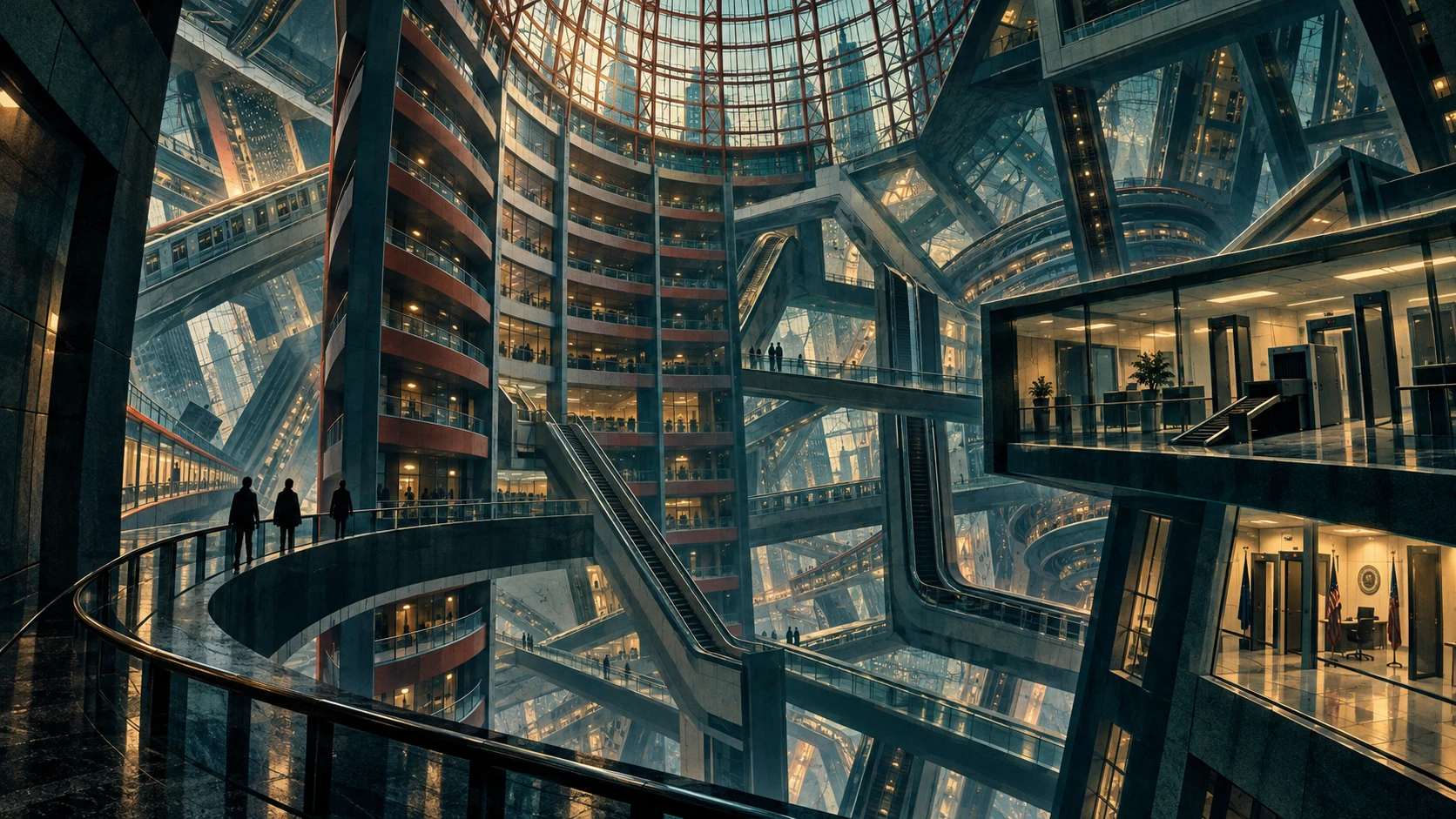
The Thompson Center becomes a shifting, bureaucratic, higher-dimensional labyrinth. Offices, transit, security, elven-airport architecture and old Chicago memories overlap.
The maze contains consequential decisions and revelations, rather than simply delaying the chase. The heroes locate the bottle’s seam, controls or an access route.
Chicago is contained property. A human could not bid directly, so a higher-dimensional being bought on his behalf. Its compensation was Chicago as a living snow globe, with the right to shake it.
The accountant Up died accidentally; his collection went to auction. This is cosmic property administration with human-sized corruption.
Working design: the seam, control system and access route are alternative discoveries serving the same forward purpose. Original gaps: navigation, security and cancellation were unfinished. The new encounter below supplies a route and a temporary legal suspension; it does not turn cancellation into an automatic campaign ending.
Sources: Session 4; bible: auction, reveal ladder and open decisions.
Optional table prep: the repossessor and custodians; see the session encounter roster for counts and scene use.
New module preparation · about 60–90 minutes · four Seasoned heroes. The original outline supplied the labyrinth and revelations, but left its rules open. This edition expands the earlier module’s five-node route. No real Thompson Center floor plan is implied. Give the players the route sketch below; hiding navigation is not the challenge.
The departure board reads CHICAGO / CHICAGO / CHICAGO. Beneath each destination is a different date. A loudspeaker apologizes for a delay in the processing of your existence.
Objective: leave with the seam diagram and the old Chicago Cyclotron route. Along the way, choose whether to rescue travelers, interrupt the shaking feed and challenge the sale. These choices change the next encounter.
Maze Shift · 0 / 4
□ 1 · delay □ 2 · warning □ 3 · approaching □ 4 · security arrives once
A · Ticket Hall → B or C. B · Elven Departures → A or D. C · Municipal Records → A or D. D · Weatherization → B, C or E. E · Control Seam → D or the cyclotron exit. All connections work both ways until the party takes the exit. Doors change their appearance, never their printed connections.
Each move takes one exploration beat: enough time to cross a corridor and have a scene. No navigation roll is required. On entering a room, describe its clue, exits and visible obstacle before asking for a decision. Returning to a room does not reset completed work.
Start at 0. Add 1 when the party repeats an already used connection without a changed plan, or knowingly accepts a delay to gain something. Warn them before either cost. A failed optional check also offers a choice: take 1 Shift and finish the attempt, or leave that optional benefit behind. Never charge both costs for the same event.
At 2, announce security over the loudspeaker. At 4, two custodians arrive at the party’s current room. Trigger this once; no endless reinforcements. They ask the visitors to return to Ticket Hall. They neither remove clues nor seal the cyclotron exit. Calder’s key (if its one use remains), a transit badge or a successful Persuasion check at TN 4 buys enough time to pass. Alternatively, use Stealth opposed by their Notice, distract them with a Test, or fight. They withdraw when one falls or a valid release order is presented.
A ticket dispenser prints the party’s names followed by “contents.” The bronze directory names Municipal Records and Elven Departures. Its service strip labels Weatherization and Control Seam; reveal the complete route sketch now.
A turnstile wants an eligible applicant. Calder’s auction key opens it without a roll, once, at any room. Otherwise sign as “authorized maintenance.” Persuasion or Electronics at TN 4 opens the turnstile; failure uses the Shift choice above. The label changes, not the heroes’ legal identity. A broad emergency walkway remains available with 1 warned Shift. The scene cannot trap the party outside the adventure.
Clue: a receipt separates “beneficiary” from “registered bidder.” Whoever profited from buying the election did not need to be the eligible purchaser.
An airport gate overlaps an office waiting room. Three travelers have boarding passes but no stable destination. Their luggage keeps reappearing at the wrong end of the corridor. They are frightened people, not combatants.
Spend one warned delay to escort them to a stable stairwell: add 1 Shift, no roll, and gain a transit badge. Athletics, Electronics or a credible magical approach at TN 4 can stabilize the gate quickly instead; failure offers the usual choice. The badge admits the party past the custodians once and marks a safe evacuation path at the cyclotron. Record Travelers helped.
Clue: the departure desk lists Chicago as a single auction lot. A traveler remembers Up boarding a higher-dimensional cruise before his accidental death. This corroborates an accident, not a murder plot. Leaving the travelers behind does not conceal the lot number.
Inez, or an unnamed estate clerk if Inez is elsewhere, shelters behind filing cabinets while invoices rain upward. Give the heroes the estate ledger immediately. Research at TN 4 finds a certified extract; failure costs time or leaves them with an ordinary copy. Both contain the essential facts.
Ledger handout: “Estate of Up: disposition following accidental death. Lot: Chicago. Beneficiary: Calder. Bidder: eligible intermediary. Compensation retained by intermediary: observation and shaking rights.” The Keeper’s proper name is blank unless your table has selected it. This proves the auction, straw buyer and payment without inventing the still-unknown origin of Calder’s technology.
The clerk can issue a temporary preservation order if the heroes show the repair invoices, the lot receipt or testimony from the travelers. No roll with evidence; Persuasion at −2 without it. Failure offers a warned delay for the clerk to find the receipt. Record Preservation order: cancel the first scheduled shake in Session 5 and release the maze custodians. It suspends harmful handling; it does not revoke the entire sale or skip the campaign’s escape.
Behind a door labeled “Seasonal Maintenance,” a municipal switchboard sends tremors to a snow-globe handling apparatus. Every shake generates a repair authorization for Calder’s firm. The next shake is visibly scheduled for the cyclotron’s second activation round.
An adjacent hero can disconnect the remote feed with Electronics or Repair at TN 4. Success records Feed cut. Failure offers 1 Shift for a slower manual disconnect, or leaves the feed intact. Cutting it cancels the same scheduled shake as the preservation order; the benefits do not stack. The beam’s own earthquake clock remains active.
An old service diagram shows a cyclotron hall stitched into the boundary from a remembered Chicago. Show the diagram even if the heroes leave the switchboard alone. They can smash the feed’s labeled breakaway relay instead: Toughness 6, any attack dealing 6 damage disables it, no Wounds or Soak. The noisy act adds 1 warned Shift. Custodians protect staff and the relay rather than trying to kill the heroes.
The atrium’s reflection contains a fine crack. A brass map traces it to the old Chicago Cyclotron, while the service lift opens onto its reconstructed high bay. Give the heroes a copy of the seam diagram and point out the sheltered lift, an exposed loading apron and the platform that can cross the seam.
The repossessor appears on a terminal to offer a service contract: stop the shakes in exchange for accepting the inventory classification. Accepting gives the same canceled round-2 shake as a preservation order; record that benefit once. It also gives the repossessor a contract to cite in Session 7, not mind control or automatic obedience. Negotiation is optional and separate from the custodian fight. It admits that the intermediary was paid in shaking rights. No roll forces the heroes to sign. Rejecting it keeps the existing exit open.
Outcome: the diagram grants one lead calibration roll +2 in Session 5. Bring forward Travelers helped, Preservation order and Feed cut. If the party is tired or fleeing security, use the marked service lift directly: they still get the diagram; unresolved security adds the two contractors to round 3, with no additional maze fight. If the party pursues cancellation as a larger campaign solution, explain the temporary order’s limit and keep that legal adventure open as a table expansion.
Offline reference: both expanded encounters. New procedures are unplaytested module additions, based on the campaign outline and earlier module preparation.
Act II · Session 5 · Planned / working mechanism
A precise shot at the seam. An earthquake if precision fails.
The party reaches the old Chicago Cyclotron, restored inside a dimensional overlap, and activates it with the SWADE task variant below under attack. Some heroes calibrate the beam; others maintain containment, supply power, fight attackers or evacuate people.
These problems happen concurrently. The earthquake is the failure clock, so the operation demands more than one person making the decisive roll.
Working fictional mechanism: the proposed geological anchor, the Sandwich Fault Zone in northern Illinois, becomes the physical shadow of a dimensional seam. Precision and resonance crack the ownership boundary. An overload transfers energy into the physical fault and makes the earthquake real.
The intended climax breaks Chicago’s container and throws the heroes into the primordial archipelago. Breaking the bottle is not the end of the campaign.
Current module choice: the old Chicago Cyclotron. The original outline left the location and failure thresholds open; the new encounter below defines a clean shot, rough shot, emergency overload and safe abort. Its reconstructed machine and geological seam are adventure fiction.
Selected branch: Chicago stays in place; a chosen shot carries the heroes adrift on the service platform. The original outline allowed either city outcome. Aborting postpones the crossing and opens a recovery scene.
Sources: Session 5; bible: breaking the bottle; eight-gathering continuity correction.
Optional table prep: Dr. Vale and rift leeches; see the session encounter roster for counts and scene use.
New module preparation · about 60–90 minutes · four Seasoned heroes. The old Chicago Cyclotron is now the selected location. This encounter supplies previously unfinished checks, pressure thresholds and branches. It is an unplaytested adventure variant of a SWADE Dramatic Task, not a reproduction of the core procedure.
The real UChicago cyclotron was completed in 1951, decommissioned in 1972 and had its magnet moved away. This adventure restores the old hall and machine through a dimensional overlap; its seam-breaking beam is fictional. Historical source: University of Chicago.
The magnet fills a hall that should no longer contain it. Hand-painted panel numbers glow through newer walls. Beyond the loading doors, Chicago hangs in glass. Dr. Vale points to a maintenance platform: “That goes through. The city stays. We need the shot to know the difference.”
Use dice or paper to record the tracks; the printed boxes below are reminders. For a different party size, choose the scaled target before initiative.
Objective: tune and fire the machine at the ownership seam, then cross on the service platform. Announce the 12-token target, four-round deadline, six-box Earthquake Pressure clock, cover and evacuation options before dealing initiative. Start both tracks at 0. Do not secretly alter their thresholds.
Five zones: sheltered control booth; power racks; magnet/containment floor; civilian loading apron; service platform. The booth connects to the racks and apron. The racks connect to the magnet. The apron and magnet each connect to the platform. Each adjacent transition is 4 tabletop inches; use normal movement and running. Booth, apron stairwell and racks’ marked shield alcove protect against the quake pulse. The magnet floor and platform are exposed. There is no compulsory damage just for entering the hall.
Four civilian technicians wait on the apron, plus Dr. Vale, who explains the diagram and points out a spare battery for the leeches. Treat each technician as an Extra: Agility d6, Smarts d6, Spirit d6, Strength d4, Vigor d6; Athletics d4, Notice d6, Repair d4; Pace 6, Parry 2, Toughness 5; no armor or weapon. Their player-directed turns can move them into cover. They do not earn beam tokens. Dr. Vale can Support one hero per round with their listed skills; they never complete the machine for the party.
Beam · 0 / 12 tokens · calibration 0 / 2 · power 0 / 2 · containment 0 / 2
Earthquake Pressure · 0 / 6 · pulse at 6, then reset to 3
Round · □ 1 · □ 2 · □ 3 · □ 4
Deal initiative normally. Each hero may attempt one task action on their turn; other actions use the core multi-action penalty. Task rolls use TN 4, normal Wild Dice, Acing and Bennies. A success earns 1 token, plus 1 per raise. Track the job beside each token. The shot needs at least 2 calibration, 2 power and 2 containment tokens within the total, so announce any missing job aloud. Two heroes can work the same job by describing separate stations.
Use core Support: a helper improves a lead roll instead of earning separate tokens. Fighting enemies, evacuation and relieving pressure earn no task tokens. A plausible different skill can work when the player names a concrete job; settle its suitability and any −2 penalty before rolling.
Club complication — this encounter’s custom override: a hero with a Club action card takes −2 on their lead task roll. On failure, add 1 Pressure. A critical failure on any lead task roll also adds 1 Pressure; never charge twice for a Club critical failure. Failure earns no tokens. These failures do not immediately end the whole encounter. Combat and non-task actions do not gain this Club penalty. Follow the core rules for Support and Joker benefits.
Evacuate: an adjacent hero spends an action at the apron to guide all four technicians into the sheltered stairwell, with no roll. If the maze travelers were helped, the marked route lets a hero do this from the booth by intercom instead. Civilians can also move themselves; a Persuasion Support action can help a frightened technician’s recovery if needed. Record who remains exposed, not an abstract casualty count.
Bleed pressure: an adjacent hero at the racks makes Repair or Electronics at TN 4 as an action. Success removes 1 Pressure, minimum 0, once per round for the whole party. This earns no tokens and does not suffer the task’s Club penalty. Critical failure adds 1 Pressure. Show the cost: one less action spent tuning the shot.
Hold the door: contractors can be persuaded to evacuate with a credible safe route and a Persuasion roll opposed by their Spirit. They leave if half their crew falls. Fighting, grappling, Tests, barricades and battery bait all work under their listed rules. None is a required kill.
Resolve events at the start of each numbered round. New opponents receive normal initiative cards that round. Resolve quake pressure after all turns, then check for the shot. Stop hostile reinforcements when the seam opens.
At each round’s end, add 1 Pressure. Whenever Pressure reaches 6, resolve one quake pulse immediately: every exposed person rolls Agility at TN 4; success gets them behind nearby debris unharmed, failure deals 2d6 damage through the core damage/armor rules. Sheltered people are safe. Then reset Pressure to 3; continue the round or shot check. The pulse damages the hall, not automatically all of Chicago. If an Extra is Incapacitated, use the table’s normal survival ruling; rescue remains possible. Never narrate mandatory deaths as a fixed ending.
12 or more tokens, with all three job minima: at the end of that round, offer the clean shot. No extra secret roll. The seam opens; the service platform carries the heroes outside while Chicago stays in place. Fire earlier than round 4 if ready. All unspent pressure is discharged safely.
8–11 tokens with all job minima at the end of round 4: offer a rough shot or withdrawal. The rough shot opens the seam but triggers one quake pulse using the procedure above, even below Pressure 6. Shelter or move civilians before choosing. Do not charge a second pulse if one already happened at that round’s end. The platform loses its crane and supplies, but keeps everyone who boarded it; it is salvageable in Session 6.
Fewer than 8 tokens, or a missing job: there is no tuned shot. Offer an emergency overload or a safe abort. The overload opens the seam, triggers the same single quake pulse and wrecks the reconstructed machine. It also loses the platform’s supplies and gives the party a damaged vessel to repair in Session 6. It does not arbitrarily kill sheltered civilians or move all of Chicago.
Abort: cut the power as an action at booth or racks, no roll. The overlap holds as a safe service passage; evacuate under the remaining enemies’ normal actions. Tokens are lost. A successful Repair action recovers a portable feed and permits a new attempt after a salvage scene; the next attempt resets tokens and Pressure and uses the same four-round clock, with enemies already defeated or persuaded staying resolved. Without the feed, Vale points to a replacement coupling in Weatherization. Aborting postpones the crossing; it does not force the heroes adrift against their decision.
After any chosen shot, describe glass becoming a horizon, then go to Session 6. Carry forward rescued technicians, any damaged platform and their relationships. The new edition chooses Chicago stays / heroes become adrift, a branch the original outline allowed but had not fixed. The later freedom and homecoming remain the intended destination.
Custom device / environmental hazard; neither a Wild Card nor an Extra. No Attributes, Wild Die, Bennies, Wounds or Soak. It does not attack or take a turn. It uses the token and Pressure procedures above.
Breakaway relay: Toughness 6; any attack dealing at least 6 damage breaks it. This stops the remote shake if broken before round 2, but leaves the local clock active.
Containment controls: Toughness 8; one hit dealing at least 8 damage disables that station, no raises or Wounds required. Calibration and power remain available; Repair at TN 4 restores the controls with an action, no token earned. Explain this consequence before a hero targets them. Cover protects technicians and controls under the core combat rules. Ordinary attacks cannot tune the seam by damaging the magnet.
Shutdown switch: reachable from booth or racks; one adjacent action aborts safely.
Service platform: holds the whole party and rescued technicians; no capacity puzzle or piloting roll for this crossing. For later voyages, choose its operating skill with the table before Session 6.
Scale: three heroes use 9 total tokens; five use 15; six use 18, always four rounds and 2 tokens per job. For three heroes, a rough shot requires 6–8 tokens; for five, 10–14; for six, 12–17. A clean shot always requires the scaled target and all job minima. For three heroes remove one leech and one contractor. Do not increase quake damage or its threshold with party size. Novice parties can use 9 tokens with the reduced opposition; imported powerful heroes require table tuning.
Same profile as the roster’s rift leech; repeated here for play.
Attributes: Agility d8, Smarts d4 (animal), Spirit d6, Strength d4, Vigor d4.
Skills: Athletics d8, Fighting d6, Notice d6, Stealth d8.
Derived: Pace 6 flying / 2 crawling; Parry 5; Toughness 4; Size 0; no armor, Edges or Hindrances.
Attack: Bite: Strength+d4, melee. No Wild Die; a Wound normally Incapacitates it.
Cable latch — custom: an adjacent leech spends an action attaching to one live feed cable. That cable’s power job is unavailable until a hero removes it with an Athletics or Repair action at TN 4, defeats it, or places a spare battery within 2 inches and spends an action luring it away. Two power stations exist; a second leech chooses the other cable. A latch never removes already earned tokens. The leech chooses current over people. A removed leech can be released outside instead of killed.
Offline reference: both expanded encounters. New procedures are unplaytested module additions, based on the campaign outline and earlier module preparation.
Act III · Session 6 · Planned
The islands drift. The sea bubbles. Your departure does not wait.

The heroes learn how to sail among reality-islands over the foggy primordial medium. Unstable physics, story logic, Mark’s electricity or salvaged auction technology may make travel possible.
Every usable slide opens during a brief, predictable window. Helping, investigating and scavenging compete with the departure clock. One or two legacy images can return as islands or hazards without consuming full side quests.
Miss the window and the party may be stuck in that reality until another route appears. Lose contact with both sides while crossing and the heroes may be marooned between universes.
That distinction is deliberate. Failure changes the route and creates play. Mark’s difficult return warned them about it before they ever saw the sea.
Planned: catch a slide, miss one and seek another route, or risk between-space stranding. Unknown: the exact rescue procedure, island sequence and travel mechanics. This edition carries the cyclotron’s service platform forward as a vessel; its operating rules remain open. The gathering ends with a route or message that can lead home; the form of that message is still open.
Sources: Session 6; bible: travel and archipelago; earlier design chat: slide windows.
Optional table prep: Sable and rift leeches; see the session encounter roster for counts and scene use.
Act III · Session 7 · Intended ending
Bring the heroes home. Leave the ownership boundary broken.
The final voyage is a group problem: navigate the sea, preserve the route, hit the last slide window and resist the owner or straw buyer’s final attempt to stop the party.
Mark’s electrical powers pay off. They may energize a vessel, steer a passage, broadcast the message or reconnect realities. These are alternative uses, not four mandatory scenes.
The party sails back to reality without restoring Chicago’s old ownership boundary. The heroes are publicly hailed as heroes.
“Chicago is safe” returns with a changed meaning. The city is free because it belongs to its people, rather than merely looking peaceful inside someone else’s collection.
Planned destination: freedom and homecoming. Working design: the electrical solution and last opposition. Unknown: exact victory conditions, partial victory, a terminal failure ending and the final opponent’s form. No recorded play fixes which route the heroes would actually take.
Sources: Session 7; bible: ending and unfinished mechanics.
Optional table prep: the repossessor and custodians; see the session encounter roster for counts and scene use.
GM background
The higher-dimensional accountant who collected pocket realities dies accidentally: the fifth-dimensional analogue of being killed by mid-range cruise cocktail shrimp. There is no secret murder. The exact mechanics are inaccessible and deliberately irrelevant.
The holding containing Chicago goes to auction. Whether the lot is Chicago, Earth, or a pocket reality containing both was never settled.
Scavenged higher-dimensional technology lets a would-be mayor make contact. He uses an eligible straw buyer to bid indirectly. The technology’s origin and the finer points of legal title remain unknown.
Chicago is its compensation. It can deliberately shake the city, causing overlaps, cartoon incursions, incompatible histories and manufactured disasters. It needs the population alive so it can keep enjoying the cruelty.
Higher-dimensional time manipulation makes the alderman mayor. Ballots, records, polling and public memory may rewrite themselves around the result. Whether the heroes remember another election remains an open clue decision.
The accelerator supplies the fictional precision needed to crack the bottle. Freedom costs the party its place in ordinary reality. The voyage home then becomes the final act.
Patterns in the disturbances. Municipal equipment near incidents. A mismatch between the apparent buyer and the beneficiary. Mark’s timed, unstable passages. These are independent evidence routes, rather than one conveniently omniscient speech.
The straw buyer’s identity, profession, audience and philosophy. Reveal its appetite and contractual rights first. The same clues can support different prepared versions without requiring a retcon.
Source: Campaign bible: estate auction, mayor, snow globe and reveal ladder; log: Rounds 6–15.
People & places
Recovered character / planned return
A returning player character with electrical powers. His portal arrival starts the campaign; his electricity helps make the voyage home possible. Origin, limits, costs and signature use of the original powers were still unrecovered; an optional NPC build appears in the stat-block reference. This account uses the fictional character, without reproducing the real player’s biography.
Unknown cast
The roster, character names, allies, enemies and last fictional statuses were not established in the available design. Choose the returning heroes for your group.
Recovered cosmology / planned estate-sale trigger
An accountant on a higher plane, worshipped by fuzzy creatures as their dimension’s keeper. He kept small universes like ant farms. His accidental death causes the auction. Investigating his death is intentionally an anti-mystery.
Planned fictional antagonist
An ambitious alderman with a home-repair and weatherization business. His personal name was not finalized in the original outline. The optional module build below uses Calder. He buys cosmic leverage and lets disasters become business.
Working design · current baseline
A collector of living habitats who calls a shake an “enrichment event.” Civilians are feeder stock; heroes are especially entertaining specimens. It might save them merely to endanger them again. Its care for the habitat is not care for its inhabitants.
Prepared alternatives · not simultaneous canon
The Naturalist defends predation and suffering as healthy ecology, backed by professional status. The Spectator is a bored entertainment addict who rewards mayhem and follows favorite residents; an audience or wagering is only an option. The GM explicitly preserved either version, or a hybrid, as an audible at the table.
Recovered history: a Chicago water-tower battle with dragons and strange wasp creatures; an elevator into an airport-shaped elven realm with automatic-weapon security; and the fuzzy creatures beneath Up. Why the battle happened, who was allied with whom, and the order connecting the scenes remain unknown. They are possible echoes in the archipelago, not a forced itinerary.
Sources: Campaign bible: recovered history, antagonists and locations; log: Rounds 1–3 and prepared straw-buyer options.
SWADE · Table reference
Eleven complete profiles, with motives, clues and tactics you can use at the table.
New preparation, not recovered canon. These optional builds use Savage Worlds Adventure Edition (SWADE) and assume four Seasoned player characters. The earlier free-module draft supplied six profiles and the supporting names Inez, Pip and Dr. Vale. This edition expands them, adds Sable and an animated ink spill, and adds an optional electrical attack for NPC Mark. The original campaign did not fix these statistics. These encounters have not been playtested.
Wild Cards: d6 Wild Die on Trait rolls; they can sustain three Wounds, and another Wound Incapacitates them. NPC Wild Cards have two personal Bennies. Extras: no Wild Die; a Wound normally Incapacitates them. Apply the core Shaken, damage and Soak procedures.
Armor is already included in Toughness and shown in parentheses. All profiles are Size 0. Unlisted skills use the core unskilled procedure. “Strength+d4” adds that character’s Strength die to a d4. Ranges and Pace use tabletop inches; one inch represents two yards. Gear and creature abilities labeled “custom” are adventure additions.
Use your core book for Tests, Support, combat, powers and Dramatic Tasks. These profiles are encounter builds, not advancement-balanced player sheets. The short rules reference was checked against Pinnacle’s official SWADE Test Drive.
Wild Card · Sessions 0, 1, 6, 7
Glad to be home, frightened of the outside, and unwilling to abandon displaced people. Use this supporting build only when Mark is an NPC; a player keeps control of their own character.
Pace 6 · Parry 4 · Toughness 5
Addition provenance: Existing module build, with a new optional electrical attack.
Wild Card · Sessions 3, 4
A contractor turned mayor who speaks of manufactured disasters as opportunities to serve. He wants status, profit and a way out of his own bargain.
Pace 6 · Parry 4 · Toughness 5
Addition provenance: Existing module addition; this name was not fixed in the campaign bible.
Wild Card · Sessions 4, 7
Courteous, precise, and convinced that residents are inventory. It would rather reclaim an asset than destroy it.
Pace 6 · Parry 6 · Toughness 8 (2)
Addition provenance: Existing module field agent and tether mechanic.
Wild Card · Sessions 6, 7
A patient salvage pilot who ties a bright rope around every promise. They want their stranded crew brought home, not another owner to serve.
Pace 6 · Parry 5 · Toughness 6
Addition provenance: New supporting character for this stat-block edition.
Extra · Sessions 2, 3, 5
A worker under an emergency contract. Not automatically a murderer; abandoned crews may surrender or help.
Pace 6 · Parry 5 · Toughness 6 (1)
Addition provenance: Existing module profile.
Extra · Sessions 4, 7
A checkpoint employee paid to guard a jurisdiction they only partly understand. They want a valid authorization and an exit route.
Pace 6 · Parry 5 · Toughness 8 (2)
Addition provenance: Existing module profile.
Extra · Sessions 0, 5, 6
A wasp-shaped tangle of electrical insulation, Size 0. It feeds on current and can be drawn away by a spare battery.
Pace 6 flying; 2 crawling · Parry 5 · Toughness 4
Addition provenance: Existing module creature and cable mechanic.
Extra · Sessions 1, 3, 4
A meticulous clerk who dates everything twice because the city’s records have started disagreeing. She wants the evidence preserved.
Pace 6 · Parry 4 · Toughness 5
Addition provenance: Existing module name; new complete profile.
Extra · Sessions 1, 2, 6
A displaced courier who insists that being drawn does not make their home less real. They want stranded neighbors reunited.
Pace 6 · Parry 4 · Toughness 5
Addition provenance: Existing module name; new complete profile and cartoon ability.
Extra · Sessions 3, 5
An engineer who labels every cable and refuses to call an earthquake an acceptable error bar. They want the installation safely shut down.
Pace 6 · Parry 4 · Toughness 6 (1)
Addition provenance: Existing module name; new complete profile.
Extra · Sessions 2, 6
A Size 0 knot of runaway drawing physics. It imitates road markings and chases movement; it is a hazard rather than a displaced person.
Pace 4 · Parry 5 · Toughness 5
Addition provenance: New encounter creature, not a cartoon resident.
Up is already dead; his estate is the trigger, not a boss encounter. The Keeper remains outside the bottle. Use the repossessor for its actionable physical opposition. A shake, ledger or tether expresses its influence; do not give it automatic extra combat turns or an invulnerable body the heroes must defeat. The Cruel Naturalist and Spectator remain alternative motives for the same role.
Counts are starting suggestions for four Seasoned heroes, not a challenge-rating guarantee. Allies do not count as additional heroes when choosing opposition.
Cast: Mark; 2 rift leeches.
Keep the leeches on cables, not civilians. Put a spare battery in view. Removing them keeps portal work available; Mark still arrives if the portal goes badly.
Cast: Mark, Inez and Pip; no required fight.
Let each supply a different anomaly or memory. Establish Pip as a person before asking the heroes to protect them.
Cast: Pip; 2 animated ink spills; 2 contractors.
The spills endanger the rescue route. Contractors are holding a cordon, not automatically attacking. Helping residents and calming the crew are valid solutions.
Cast: Inez, Calder and 3 contractors.
Calder flees or bargains. His files and key survive capture, surrender or escape; the next clue is not locked behind keeping him alive.
Cast: Inez; 2 custodians; the repossessor.
The four-box Maze Shift brings custodians once. The repossessor appears remotely for an optional contract conversation; its Wild Card combat profile is reserved for a later physical meeting.
Cast: Dr. Vale; 2 contractors; 2 rift leeches.
Split pressures across guarding, calibration and feeding cables. Use the complete old cyclotron task above: 12 tokens in four rounds, three jobs and a six-box earthquake clock. Its installation and repeated leech stat blocks sit beside the procedure.
Cast: Sable and Mark; either 2 leeches or 2 ink spills.
Choose one short salvage complication. Show the departure window first. Avoid another long fight if the voyage is already behind schedule.
Cast: Sable and Mark; the repossessor plus 2 custodians.
Make the tether visible and reachable. Severing it or winning its release opens the last passage; killing every opponent is unnecessary. Preserve the intended freedom and homecoming.
For three heroes or Novice characters, remove one hostile Extra from each scene and keep hostile Wild Cards in separate encounters. For five or six heroes, add one or two Extras before raising dice or damage. Powerful imported heroes may need a different baseline; agree their builds first. Savage Worlds can turn sharply on an Acing damage roll, so these counts need table testing.
Show cover, exits and noncombat solutions before initiative. Cut reinforcements when the scene objective is accomplished. Allies usually offer one Support action or access to a clue; hand their control to players when appropriate. Keep the heroes responsible for the decisive tasks.
Choices, costs & consequences
The session spine fixes the intended revelations. Player choices were meant to alter routes, costs, allies and new canon. These are the branches actually supported by the notes, with an explicit limit on what is known.
Working design · Session 0
Mark still arrives. A leak, damage, an unwanted passenger or another complication carries failure forward. The particular complication was not selected.
Planned alternatives · Session 3
Both routes lead toward the Thompson Center, but change whether the heroes are pursuing a fugitive or walking into a chosen arena. No complete ambush encounter was written.
Working design · Session 5
Mistuning couples the seam to the physical fault and turns the earthquake clock into an earthquake. The original outline did not define a casualty total or a passage for every failure. This edition’s Session 5 offers a rough shot, voluntary overload or safe abort; exposure and actual damage rolls determine casualties.
Planned consequence · Sessions 6–7
The party stays in that reality until another route appears. Losing both anchors during a crossing risks marooning them between universes. Neither is automatically a written terminal ending.
Unknown legal branch
Could cancelling shaking rights invalidate the sale? Does the straw buyer retain title? The bible asks these questions. The new maze permits a temporary preservation order, which stops one shake without automatically invalidating the sale.
Plausible extrapolation: rescue work during the cartoon incursion could yield allies who help with evacuation later. Conversely, a party that chases the owner while neglecting civilians could return to a more complicated reception. Both follow the stated emphasis on meaningful choices and real consequences, but neither is a documented event or alternate finale.
Sources: Sessions 0, 3, 5, 6 and 7; bible: tone, travel and unresolved ownership law. Extrapolations are new editorial possibilities.
The intended finale
The intended ending: the heroes sail home, the old ownership boundary stays broken, and the city hails them as heroes.
The first “Chicago is safe” is a comforting assumption. The final one is an earned political and cosmic fact within the fiction: the city is no longer someone else’s toy. Mark’s impossible arrival has become the first clue to the shared voyage that brings everyone back.
Planned ending
Break the bottle; navigate home; do not restore the old ownership; receive a public heroic welcome. This is the only fully stated final destination.
Plausible extrapolation
The city could be free while the heroes remain stranded after a missed slide. The travel rules permit the complication; the notes do not declare it a final ending.
Unknown finale states
The earthquake offers a possible cost; the owner’s last intervention offers resistance. Exact partial victories, sacrifices, terminal defeats and recovery routes were not chosen.
The source outline leaves alternate finale outcomes open for the GM to prepare. A failed roll does not establish a different ending on its own.
Sources: Session 7; bible: campaign ending and mechanics still to choose.
Why it was built this way
The opening portal teaches the system by doing. A full cartoon gathering makes coalescence tangible. The investigation turns episodic weirdness into a coherent acquisition mystery. The maze is a revelation-bearing location. The accelerator asks the whole party to work at once.
Two gatherings remain after the bottle breaks. That gives the outside room to be a place, and timed slides give every stop a meaningful clock. Comedy carries actual stakes; failure makes complications rather than closing the story.
The archipelago adapts imagery from the GM’s novel The Witch Who Sold the World: floating worlds above a liquid-nitrogen sea, higher-dimensional auction lots, and Claire perceiving and rewiring their connections.
The tabletop medium is a bubbling, foggy primordial sea. This is an intentional remix with Ink and Paint, not a canonical sequel to either book. No literal witch needs to have sold Chicago.
Sources: bible: design rules and primordial archipelago; log: pacing verification and source-book connection; Hazelton manuscript.
This account was assembled from the current campaign Pages and the original reconstruction work, reviewed October 8, 2026. Source names below link within this guide. The private originals, player intake and correspondence are not bundled into the public-facing files.
Current campaign history, cosmology, estate auction, human owner, straw buyer, reveal ladder, rules intent and open decisions. Primary source for the GM guide.
Eight gatherings means Session 0 plus Sessions 1–7. The design discussion explicitly preserves the possibility that Chicago stays in place while the heroes become adrift.
Every page remains an unplayed plan with an unfinished prep checklist.
Recovered ten-year-old images; explicit GM decisions; superseded six- and seven-gathering scopes; the preserved antagonist audible; accelerator options; archipelago imagery; and the final eight-gathering spine. Later decisions take priority over earlier guesses.
Source imagery for floating worlds, the nitrogen sea, auction infrastructure and Claire’s rewiring. The campaign bible and reconstruction log document the adaptation and canon boundary.
Confirm the eight-gathering scope and the intention to let player memories inform the revival. Private answers are not reproduced. The local “New SW game” sources folder contained no synced files at review.
The prior conversation supplies the open-GM-notebook framing and intention to share the craft. It supplies no additional plot.
The original outline left edition and starting Rank, the returning roster, Mark’s power build and NPC statistics open. This module now offers a SWADE / four-Seasoned-hero baseline and optional stat blocks. Sessions 4 and 5 now include a maze route, ledger handout, linked benefits, the selected old cyclotron, task actions, hazard and creature blocks, and shot/abort outcomes. Remaining choices include other encounter maps; the straw buyer’s final persona; ownership law beyond the temporary suspension; the technology’s origin; election memories; the vessel’s later voyage rules; island order; final opposition; and alternate campaign endings.
These gaps were part of a flexible preparation strategy. Later gatherings were to become fully runnable after earlier player choices. Use the documented outline as a foundation, and make these choices to suit your group before running the relevant gathering.
This adventure was conceived and directed by a human using AI-assisted tools. Human-directed AI tools assisted the campaign’s development and this website’s writing, assembly and new illustrations. The illustrations are interpretations of documented plans; they are not recovered session artifacts.
You’re welcome to use this framework at your table. Adapt the encounters, choose the details that suit your group, and leave room for the players to surprise you.
This game references the Savage Worlds game system, available from Pinnacle Entertainment Group at www.peginc.com. Savage Worlds and all associated logos and trademarks are copyrights of Pinnacle Entertainment Group. Used with permission. Pinnacle makes no representation or warranty as to the quality, viability, or suitability for purpose of this product.
Pinnacle’s Fan License terms · Source repository and reuse notices