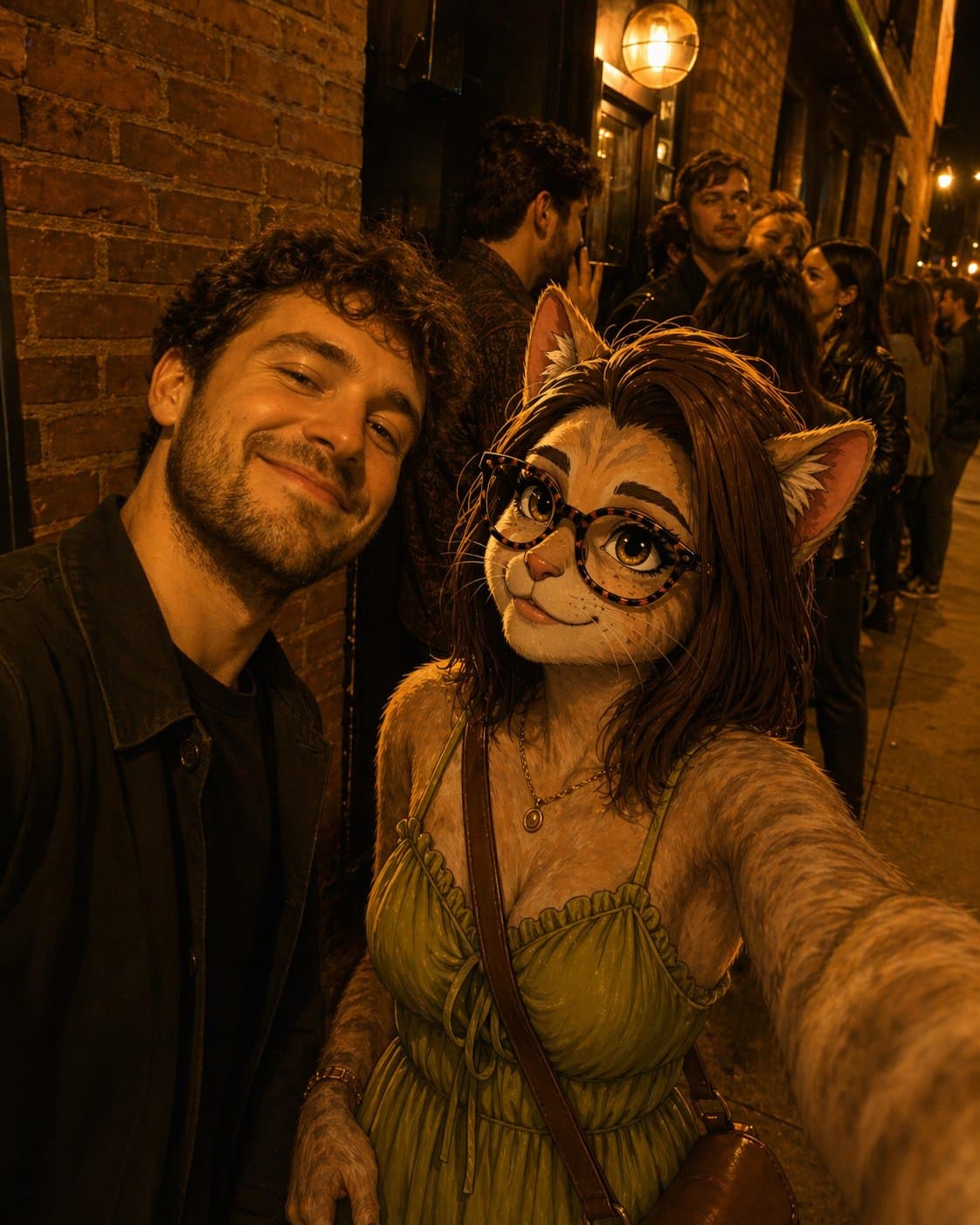
My first Midwest FurFest was in 2003.
I drove up with a Republican rabbit who insisted that I needed to experience the furry community for myself. He was right.
Through MFF, I encountered people, ideas, identities, and ways of living I had never had access to before. Furry expanded my understanding of what a life could look like, and through the community it built, I eventually found the courage to change my own life completely.
I transitioned. I moved to Chicago to be closer to my furry friends. I integrated my life with this community.
And I did not simply attend it.
I have written furry fiction for decades, including work from the early years of the Ursa awards. I am a founding member of the Furry Writers’ Guild, and I helped contribute to the literary culture of this fandom while it was still defining what furry fiction could be. I have attended MFF for 23 years and volunteered for six.
Furry has not simply been a hobby I visit once a year. It is one of the communities that made me who I am, and one I have spent much of my adult life contributing back to.
Why this matters to me
That is why the convention’s stance toward AI has been so painful.
Since the emergence of modern generative AI, I have increasingly found myself castigated, othered, and treated as lesser within the community because I use these tools in both my creative and technical life.
For me, some of these tools are not novelties.
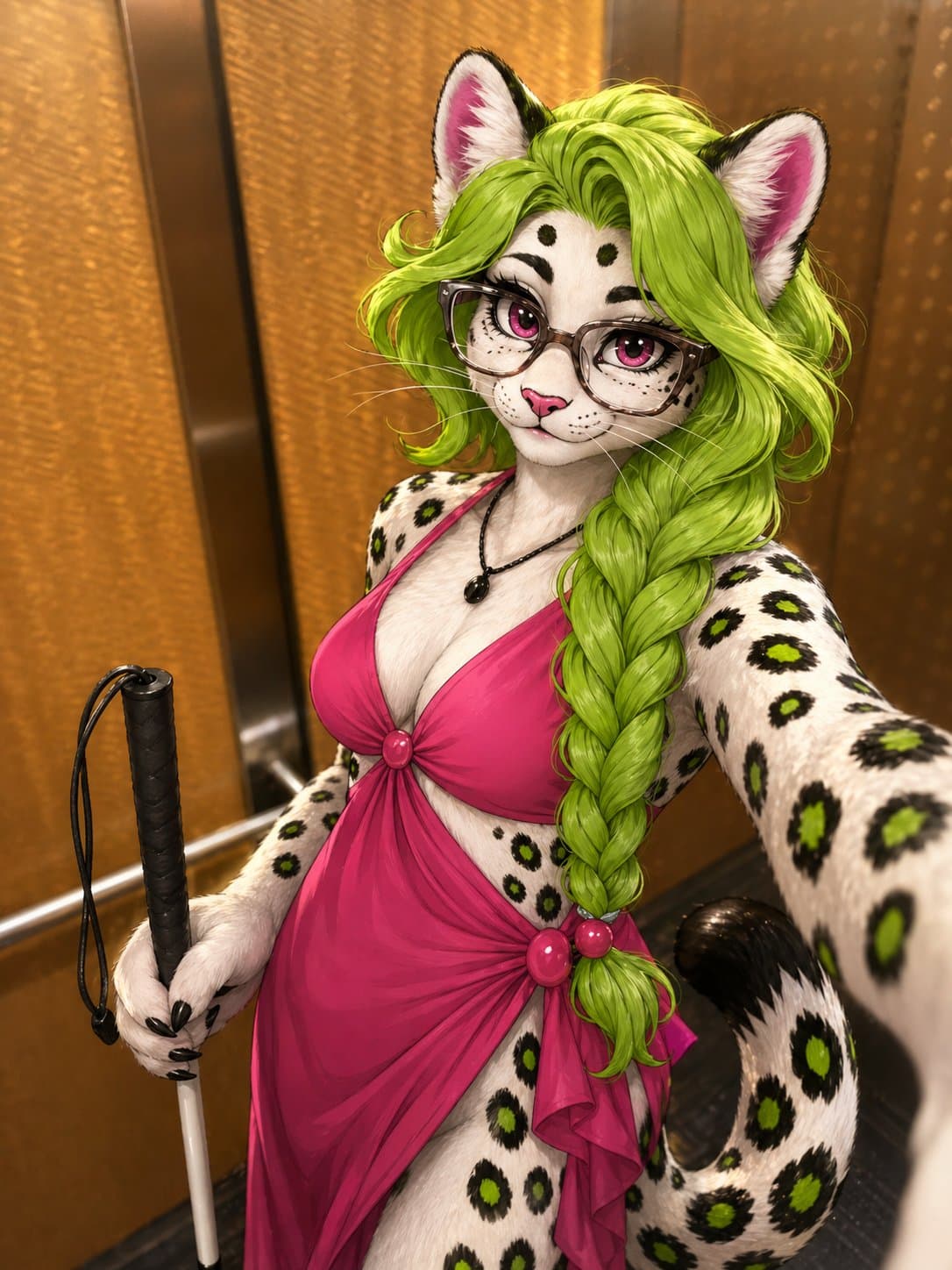
I have low vision. AI vision systems have become transformative accessibility tools, allowing me to interrogate images and physical spaces in ways that were previously difficult or impossible.
And I cannot draw.
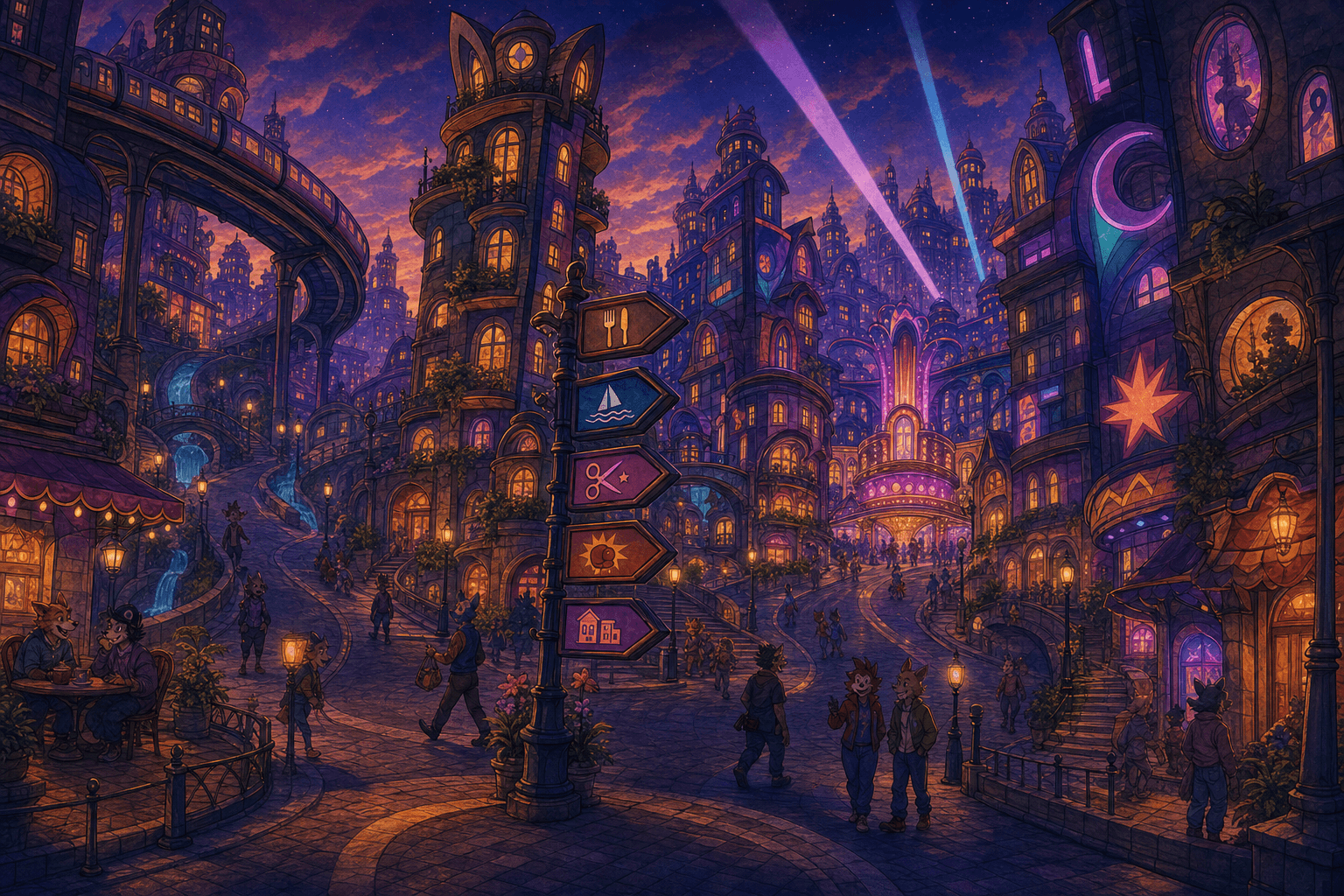
So when image generation became available, I became fascinated by it. For the first time, I could explore a visual imagination I had spent my life largely unable to express directly. I could experiment with character design, composition, environments, and storytelling in ways that had never been available to me.
Increasingly, that has made me wonder whether there is still room for people like me here.
I do not believe that should be the answer.
The narrow claim
But I want to be careful about the claim I am making, because the argument that gets shouted down in this fandom is not the one I am here to make.
I am not claiming that generative AI is good for artists. I am not claiming that furry owes this technology a welcome, or that anyone has to like it. I am claiming something narrower: a community institution should be extremely careful about adopting a blanket cultural prohibition on a fast-moving creative technology when that prohibition risks excluding creative work made through AI-mediated accessibility workflows, alongside software, experimental practice, and work already being made by people inside this fandom.
You can be deeply skeptical of generative AI and still agree with that sentence. That is the entire reason I am writing it down.
Primary source · added October 4, 2026
What Midwest FurFest’s rule actually says
The current policy reaches works “displayed, exhibited, sold or played,” not only merchandise offered for sale.
This screenshot is rendered from Midwest FurFest’s live Alley & Marketplace Rules page. It was added to this public record on October 4, 2026; the linked policy page remains the controlling primary source if MFF later changes the text.
Name the harm
Before I say anything else about possibility, let me say what I believe about harm, because I do not think the artists in this fandom are being irrational.
These models were trained on enormous amounts of work, including furry work, without anyone asking. Style mimicry can be used to impersonate a specific artist who spent fifteen years developing that style. Sheer volume can bury careful work under an infinite supply of cheap approximations. Commissions are how a real number of people in this community pay rent, and the pressure on that is neither hypothetical nor far away. The fear that a tool trained on your labor will be used to underprice your labor is a reasonable fear, and it gets validated in public most weeks.
I do not think any of that is settled, and my enthusiasm does not answer it.
But protecting artists from those harms does not require the rule Midwest FurFest has adopted. Every harm in that paragraph has a name: undisclosed authorship, style impersonation, commercial substitution, contest eligibility, spam volume, provenance. A policy can name those and go after them directly — and it can be enforced against anyone who does them, with or without a model involved.
Naming the tool instead catches all of that, and then keeps going.
That is where I come in.
A different way forwardThis does not have to be a binary choice.Three policies that are neither ban nor free-for-all
These are examples, not demands. MFF does not need to adopt my preferred AI policy. I want us to recognize that the choice is not simply prohibition or anything-goes.
Human Authorship
Permit AI-assisted work when there is meaningful human creative direction. Require disclosure. Allow the convention to ask about process. Direct prompt-to-product merchandise can remain prohibited.
Commercial Boundary
Keep primarily generated visual artwork out of Artists Alley and the Dealers Den while leaving room elsewhere for software, accessibility tools, games, animation, storytelling, and interactive experiences.
Experimental Track
Create a clearly labeled emerging-technology space for one year. Require disclosure and consent safeguards. Invite builders and critics. Collect feedback, then revisit the policy.
Regulate conduct, not the tool
Part of what makes a blanket rule so hard to write well is that “AI” is not one practice.
The word covers a finished piece sold in place of a commission, a vision model describing a photograph out loud, code completion, image tagging, a character reference system, an animation pipeline, a local model running on somebody’s own machine, procedural generation in a game, and a dozen things that do not have names yet. Those are not the same act. A few of them take a sale away from an artist. Most of them never touch one.
This is why I keep coming back to my own eyes, and it is not a request for an exemption.
For me a vision model sits closer to my white cane than to a print shop. It is the interface through which I get at an image at all. The identical technical mechanism is a substitute for an artist in one use and an adaptive device in another. A rule aimed at the mechanism cannot tell those two apart. A rule aimed at the conduct can.
More importantly, an accessibility workflow does not stop being an accessibility workflow merely because it helps produce a finished creative work. A blanket rule can therefore catch the novel, image, game, or other artifact produced through that workflow even when the role of the model was to compensate for a disability rather than replace human authorship.
There is also a question of scope. Rules about what can be sold at a table are marketplace rules, and MFF is entitled to write those tightly: an Artists Alley exists to protect and promote the people selling in it, and provenance, copyright exposure, and direct competition are real administrative problems. But the moment a policy governs which kinds of creative practice count as acceptable participation in the convention at all, it has stopped regulating a marketplace and started drawing a cultural boundary around who belongs here.
Those are different powers. They deserve different amounts of caution.
What gets lost in a blanket ban
AI contains extraordinary possibilities for the furry community. These are tools for accessibility, play, experimentation, software, games, animation, storytelling, and forms of creativity we have barely begun to invent.
I reject the idea that the future must be framed as Artists vs. AI. Artists are already using AI. So are disabled people, programmers, writers, musicians, animators, hobbyists, makers, and people who previously had no practical access to certain creative media.
This is not a replacement for creativity. It is another creative medium entering the room.
And furry, of all communities, should understand that new tools do not erase old ones. We did not stop drawing because digital art arrived. We did not stop making costumes because 3D printers appeared.
We added more ways to create.
That is what I want AI to become here.
I remember having this argument beforeThe tools changed. The artists stayed.2011, the iPad, and the argument we are having again
Around 2011 and 2012, while attending conventions including Furry Connection North and IndyFurCon, I remember arguments about artists bringing iPads and other digital drawing tools into convention spaces traditionally organized around paper. This is my personal recollection, not a claim that either convention maintained a formal ban.
Does someone drawing on an iPad belong in an Artists Alley built around paper?
Digital illustration is an ordinary part of furry art and convention culture.
Generative AI is not digital illustration, and its questions around training data, consent, attribution, and commercial competition are different. But I recognize the reflex: a new tool changes what is easy and difficult, and suddenly we find ourselves arguing about whether the people using it are artists at all.
I used to think that reassured us: furry already had this argument once and got past it. I no longer think that. Since 2022, Fur Affinity has banned AI-generated art outright. NordicFuzzCon and Citrus Con have adopted bans of their own in their Artist Alleys and Dealers’ Dens. IndyFurCon — the very convention where I remember arguing about iPads — now prohibits AI in its Artist Alley too.
The same reflex is happening again, this time across the whole fandom at once. I don’t think that should reassure anyone. I think it should worry us.
The technology will not sit still
This technology is also moving absurdly fast.
A rule written with 2023’s image generators in mind will still be on the books when it governs 2028’s accessibility software, animation pipelines, and whatever the next unnamed thing turns out to be. A policy built around a mechanism ages badly, and it has to be defended as a moral position long after the mechanism has changed underneath it. A policy built around behavior can be revised without reopening the entire argument every time.
And this is not Silicon Valley knocking on furry’s door.
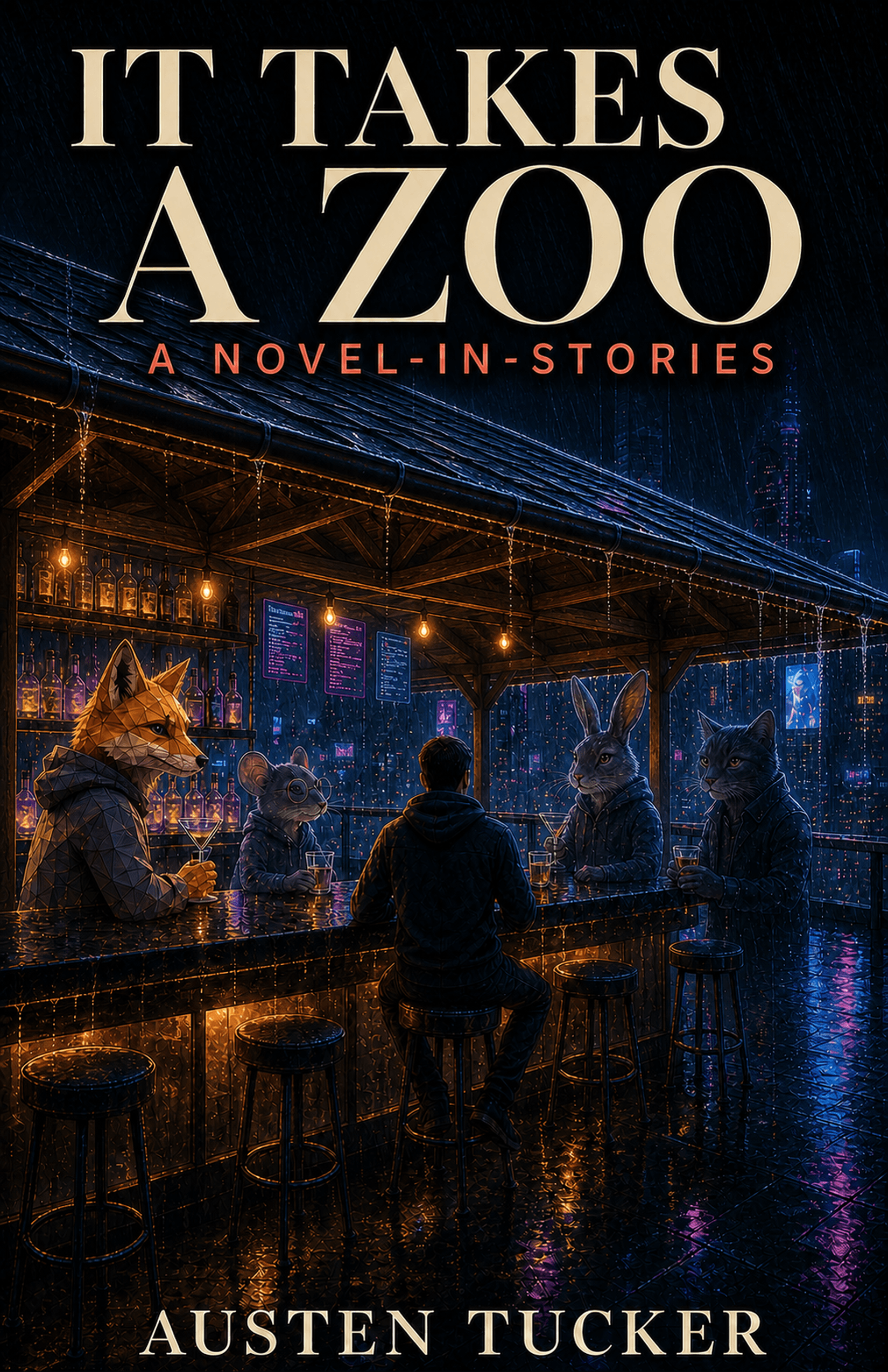
I have been making this argument in public, under my own name, on my own site, for years — including the case that an AI-mediated image can be a disposable, personal kind of expression rather than a replacement for a commission. There are furs already building with these tools for furry purposes: characters, stories, games, accessibility, software. The disagreement is already inside the house.
An institution should be slow to settle an internal dispute by defining one side of it out of the community.
Why I am stepping away
Until Midwest FurFest’s anti-AI policy is materially revised or eliminated, I will not be volunteering for or attending the convention.
That is not a decision I make lightly, and I want to be precise about what it is.
It is not an ultimatum. I am not offering to trade my labor for a policy change, and the board should not revise anything because one volunteer is unhappy. MFF will be fine without me.
It is that volunteering is a form of endorsement. I cannot help administer a boundary that places work I believe is legitimate, accessible, human-directed creative expression on the wrong side of it. I would rather withdraw than take a shift while pretending the disagreement is a small one.
After more than two decades as an attendee and member of this fandom, I finally feel that I have something uniquely valuable to contribute to its next chapter: decades of creative work, two decades of technical experience, and direct experience building with a technology that will shape much of what comes next.
If the convention has decided that this kind of exploration is incompatible with the community it wants to build, then there is no meaningful place for me in that world.
I have put my own history in this letter because it shows who a rule like this excludes. It is not the reason the rule is wrong. Take my name out of this letter and the argument should still stand on its own — and if it does not, then it is not worth revising a policy over me.
A risk, not a prediction
The attempt to drive AI art from the furry community has not made it disappear.
Instead, it has begun driving some of its creators elsewhere.
the views my AI-assisted images get on DeviantArt compared to comparable work on Fur Affinity. Fur Affinity has prohibited AI-generated art outright since 2022, so the comparison is not entirely fair — but the gap in attention is real, and growing.
I am watching from the inside as something small begins to take shape: private Telegram channels, Discord servers, informal groups, and communities built around sharing work that has become unwelcome elsewhere.
Nothing enormous yet.
But this is no longer hypothetical.
Outside furry, AI-art communities have already grown large enough to develop their own social infrastructure: galleries, Discord servers, contests, marketplaces, collaborative tools, shared techniques, and their own emerging creative culture.
Inside furry, the beginnings are smaller. There are already groups explicitly devoted to AI-generated anthropomorphic artwork. I am in some of these spaces. I can watch this process happening in real time.
That concerns me.
Not because I believe people using AI should be driven away, but because I believe the opposite.
I am already watching some of these spaces attract people whose values are far less aligned with the openness, creativity, consent, experimentation, and mutual care that furry communities have spent decades trying to build.
When people who want to use these technologies responsibly are told that the technology itself makes them unwelcome, they do not necessarily stop using it.
They find somewhere else to go.
Today these communities are small.
They may not remain that way.
One day, someone with money may decide that instead of fighting for a place inside furry’s existing institutions, it would be easier to build new institutions around the art those communities rejected.
Maybe that never happens.
I hope it doesn’t.
I am not predicting a schism. I am pointing at a plausible risk: exclusion can move people into parallel spaces, and parallel spaces can develop their own institutions, incentives, and norms. I do not think we should assume that exclusion makes the underlying community disappear.
Bring the machine into the room
So I would rather make an offer than an argument, and the reason why is a story about this city.
New York City banned pinball in 1942. It was classified as gambling — a game of pure chance, a machine that took children’s money — and the ban held for thirty-four years. Nobody at City Hall thought it was a close question. Machines were seized and broken up for the cameras.
In 1976, the industry sent a writer named Roger Sharpe to testify before the New York City Council. He did not win by explaining that the council had misunderstood the technology. He won because somebody wheeled a machine into the room. He told the council there was skill in it — that if he pulled the plunger back just right, the ball would go down a particular lane — and then he did it. The council voted to lift the ban. By Sharpe’s own account since, the shot was mostly luck.
Chicago, which built the machines, kept its own ban until January 1977.
The lesson I take from that is not that the skeptics were fools. Much of what was said about coin-operated machines in 1942 was true of coin-operated machines in 1942. The lesson is that the argument did not move while it stayed abstract, and it moved the moment there was an actual thing in the room to look at.
So I am offering to bring the machine into the room. I will demonstrate my own software and my own work to the board — in person, on a projector, with hostile questions welcome, including from the artists in this fandom who have the most to lose if I turn out to be wrong.
I believe code wins. A working thing, in the right room, can move a conversation that abstract argument cannot.